Hear this out. Organic traffic from 2 billion users. A revenue split that beats the industry average. An ad ecosystem running on Google’s infrastructure — and already showing 10x month-over-month growth. Here’s why this is the moment to get in.
What Are YouTube Playables?
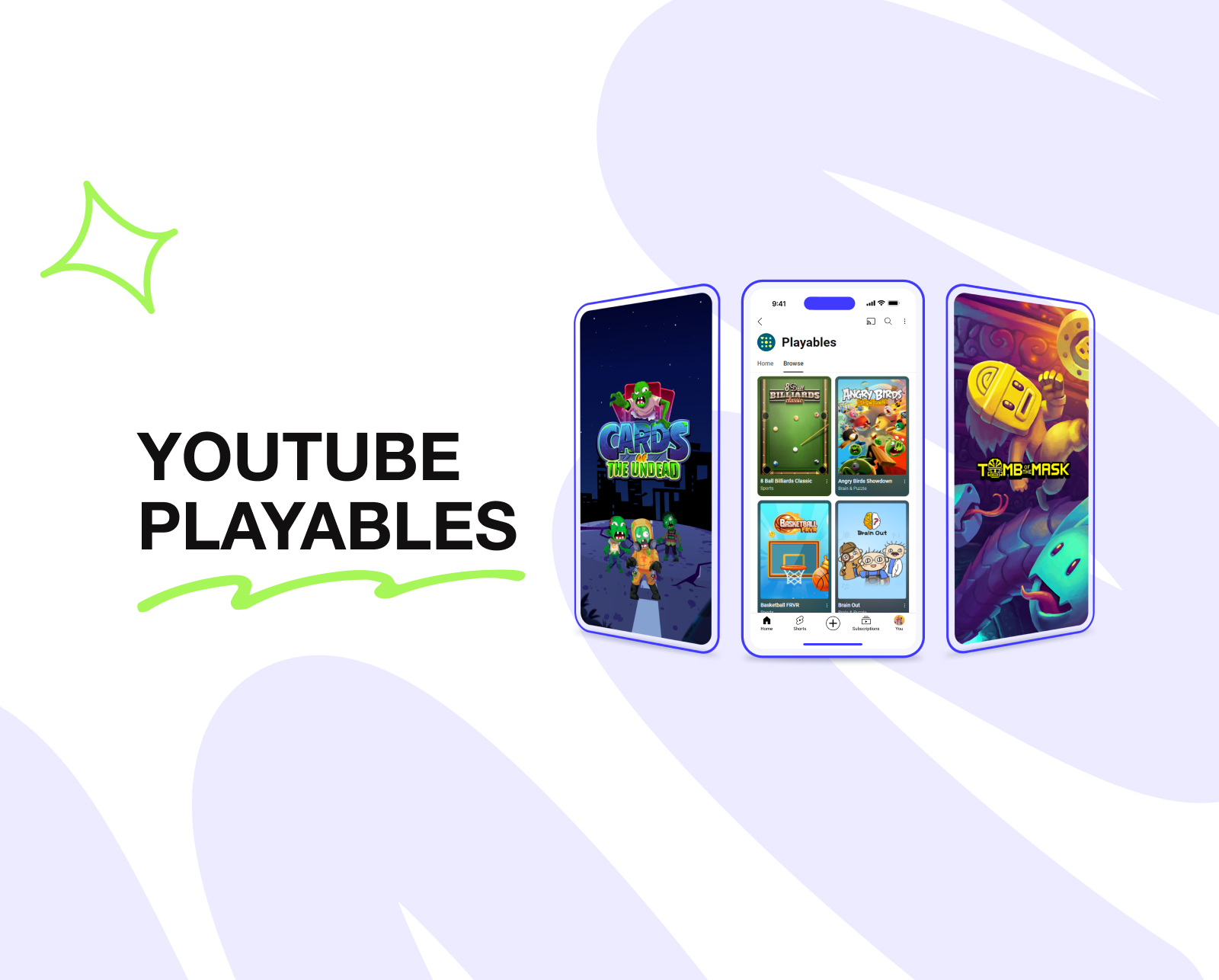
YouTube Playables is Google’s new in-app gaming layer, a collection of browser-based games (HTML5, WebGL, Canvas) that can be played within the YouTube app. They’re hosted on a massive platform that has 2,7+ billion registered users, around 122 million daily visitors, and an audience that watched an astonishing 2.2 billion hours of gaming content in Q2 2025.
The service is still in beta and running in a few markets: the US, Canada, UK, Australia, India, Malaysia, and Turkey.
Publish your Game on YouTube
Publish games faster, manage monetization, receive fast and secure payouts worldwide, and get premium tech support from a team that helps developers grow globally.
Apply NowWe Were Among the First Accounts Accepted Into Monetization
Revenue sharing on Playables is rolled out in a pilot mode with selected publishers. Mediacube was chosen to get in on that pilot early, and since April 2026 we’ve been closely following how monetization is shaping up: what has been achieved so far, what is still being adjusted, and where the platform is heading.
Right now, the analytics layer is still shaping. YouTube is essentially building this infrastructure as they go along. But this is the important bit: the monetization is already functioning, it’s real, and it’s increasing.
Looking at the revenue from our full portfolio from May to June 2026, we saw a pretty amazing 10x growth over the course of just one month. We are expecting that sort of growth to keep on going as the platform starts to get more exposure to advertisers and the fill rate gets better.
How Monetization Works: Three Ad Formats

The YouTube Playables platform uses Google AdSense as its advertising infrastructure. Every ad appearing in a game has been reviewed and approved by YouTube — no third-party ad networks, no brand-unsafe inventory. For developers, this means the ads running in your game will always be clean.
There are three formats:
Pre-roll ads — pop up whenever a game is launched, no special work is needed from the developer, and they can’t be turned off. So users will get a pre-roll ad every time they start the game.
Interstitial ads — the developer decides when to stop the game mid-action and show an ad. To get the best results, you should avoid putting interstitials in the first levels of a game, because if you plop too many ads in there, players are likely to get frustrated and bail before they even get hooked. We recommend waiting until level 4-5 to introduce interstitials, once your player has been engaged long enough to be invested in the game.
Rewarded ads — the ones where a player voluntarily agrees to watch an ad for in-game reward (e.g. an extra life, coins, or a level skip). You are not obligated to add it if your game’s mechanics don’t support rewarding players this way. But if it does, rewarded ads tend to deliver the highest engagement and CPM of the 3 formats.
What Drives Revenue
With limited data to go on, we still can observe certain patterns from the user behaviour. This is what we’re seeing:
- Session depth beats session count. A player who stays in game for 10+ minutes is going to see a lot more ads than ten players who pop in and out in 30-60 seconds. Games that manage to hook players in a way that makes them lose track of time tend to rake it in from advertising.
- Engagement matters when it comes to the YouTube algorithm. Strong retention metrics → game gets surfaced to new players → more sessions → more ad impressions → stronger algorithmic signal → more players. It’s a self-reinforcing feedback loop, and the games that click with audiences fast end up building a solid lead.
- Geography is the biggest factor in CPM. Because Playables are available in a limited set of markets, the audience we have at the moment is skewed pretty heavily towards tier-1 countries and the advertising rates that come with that. The average CPM on Playables is already higher than what a lot of well-established web gaming platforms manage to get. As it expands into more countries, the mix of the audience is going to change, but as of now, the composition is favorable.
What the SDK Gives You Beyond Ads
The Playables SDK isn’t just a way to stick ads in your game. There are two other features worth mentioning, as they definitely have an impact on ad revenue:
- Cloud saves (saveData / loadData) — this means players can pick up where they left off, on whatever device they happen to be playing on, and it certainly makes them more likely to come back to your game.
- Score submission (sendScore) — games can push scores to YouTube, which in turn lets players come back for more. The end result is more time spent playing your game, and that means more ad time.
Neither of these features are obligatory, but they both have a noticeable impact on the metrics that drive your game’s success and revenue.
What About YouTube Premium Users?

YouTube Premium subscribers don’t have to deal with ads on the platform and in Playables, but the developers aren’t missing out either. YouTube’s standard model splits the monthly subscription fee among the creators and it’s based on how much time the subscriber spends watching their content. That means if a Premium user spends 20 minutes playing your game, that counts as part of their subscription share instead of ad impressions.
From Mobile Games to YouTube Playables
If your games are live on the App Store or Google Play, Playables may feel like a distant platform, but the technical part is simpler than most mobile developers expect.
Supported engines: Unity (WebGL export), Cocos2d, Phaser, Construct, Framer. If you’re already building in any of these, you have a web export path.
What changes: SDK integration (the Playables SDK replaces third-party ad networks), ensuring the game pauses and mutes audio correctly when backgrounded, and removing any external API tools (YouTube doesn’t allow third-party SDKs or external API calls alongside its own).
What stays the same: game logic, art assets, level design. A well-structured mobile codebase typically ports in days, not weeks.
The practical entry point: if you have a single-player casual or arcade title on mobile, ask yourself whether a web build is achievable with your current engine. If the answer is yes, it’s worth the conversation.
Ready to Launch on YouTube Playables?
Create your account and get everything you need to publish, monetize, and grow your game globally.
Get StartedWhy Partner with Mediacube for YouTube Playables
Publishing on YouTube Playables is not only uploading a game. It involves deep integration with the platform, navigating certification and compliance laws, and keeping on top of the still changing YouTube landscape. As an official YouTube partner for over 10 years now and one of the earliest publishers to get accepted into that Playables monetization pilot, Mediacube is here to guide you through all of that complexity from start to finish.
We provide the technical guidance, review your builds before you submit them to Playables to avoid any possible certification issues, handle publishing of your game through our established Playables setup, and manage monetization and payouts through a single partnership with us. And since we’re already working with hundreds of Playables, we get to see:
- all the latest platform updates,
- monetization trends,
- and best practices.
We pass all that useful knowledge directly to our partners.
Rather than spending months and months trying to figure it all out on their own, developers can focus on building great games while we sort out publishing, monetization, and operational support.
From Upload to First Revenue: What to Expect

Here’s a realistic picture of the timeline for a game going from “ready to publish” to earning step-by-step:
Onboarding and SDK Integration
We’ve seen this process take anywhere from one day for a clean codebase and web-native game to 1–2 weeks for mobile ports requiring additional refactoring.
Pre-Certification and Upload
This catches common issues — such as audio not muting on pause or external API calls appearing in console logs — before they become rejection reasons.
Once everything passes validation, the build is submitted to YouTube for final review.
YouTube Certification and Release
Working with an established publishing account significantly reduces both rejection risk and time spent waiting in the review queue.
Once certification is complete, the game goes live.
Revenue Ramp
The bigger variable is discovery. Games that the algorithm picks up early can experience rapid session growth during their first month.
That’s why optimizing session depth and engagement quality from the start is so important.
The Revenue Split and How Payouts Work
Standard publishing terms through Mediacube mostly depend on the title brought to our attention. We also have a grading structure for projects that start to hype really fast. Besides, the developer partnering with Mediacube generally can make a bigger revshare compared to other platform and stores.
The arrangement is non-exclusive. Your game stays live on other web platforms, or mobile stores. Playables revenue is additive, not a trade-off, so your other revenue streams stay intact.
Payouts go through MCPay: 80+ currencies, 12+ withdrawal methods including bank transfer and crypto. Revenue is denominated in USD; you choose the timing and destination of each withdrawal with a minimal fee.
Why the Timing Matters
Platforms with 2-billion-person audiences don’t open a new content category very often. But when they do and when they’re still trying to figure out how to make a profit out of it, there’s a brief window where competition is thin, algorithms are still trying to figure things out and distinguish quality from non-quality, and early publishers accumulate data history that late entrants simply can’t replicate.
Algorithm history — games published now build engagement signals from day one. When YouTube’s recommendation engine matures, those early signals end up becoming the benchmark as to how all the other games are judged.
IAP readiness — in-app purchases are expected to arrive by the end of 2026 or into 2027. Games with an established player base on the platform will convert to IAP revenue from day one. Games that enter after IAP launches will be starting from zero.
Analytics benchmarking — with no established norms to compare against yet, developers publishing today get to help set the bar for what is good on Playables. In other words, they get to influence and find out which game types perform, which ad placements will work & which session lengths are likely to predict decent revenue.
No UA cost, ever! Because YouTube’s algorithm is bringing the traffic in organically, so developers don’t have to worry about cost-per-install to recoup. No media budget to sort out, but every single session is pure profit.
Frequently Asked Questions on YouTube Playables
We’ve collected the most typical questions in regards to how to work with Playables in the correct way.
Yes, you can. Also, publishing through Mediacube is non-exclusive. You can have your game on every other platform, while it is monetized on YouTube Playables.
No. Most games built with engines such as Unity (WebGL), Phaser, Construct, Cocos Creator, or similar HTML5-compatible technologies only require a web build, Playables SDK integration, and several platform-specific adjustments. The core gameplay, assets, and progression usually stay the same.
You can start getting revenue within a few days after your game gets certified and goes live, thanks to the auto-play pre-roll ads. However, the more players keep coming back and playing, the more you can expect to earn.
Simply apply your games on MC Play and share some project details. If we think it’s suitable for YouTube Playables, we’ll walk you through the whole process and help you get everything set up from start to finish.
Why a Publisher Changes the Math
Getting direct access to Playables without a publisher means waiting 5–6 months for approval. Mediacube is one the largest publishers on Playables today, with more than 50 titles published that generate around 16M game plays daily, and early access to such features as monetization.
For developers, that means: faster time-to-revenue, no approval uncertainty, and a partner that has been inside the monetization pilot since the beginning. We’ve been watching, learning, and applying those lessons to our entire portfolio in real time.