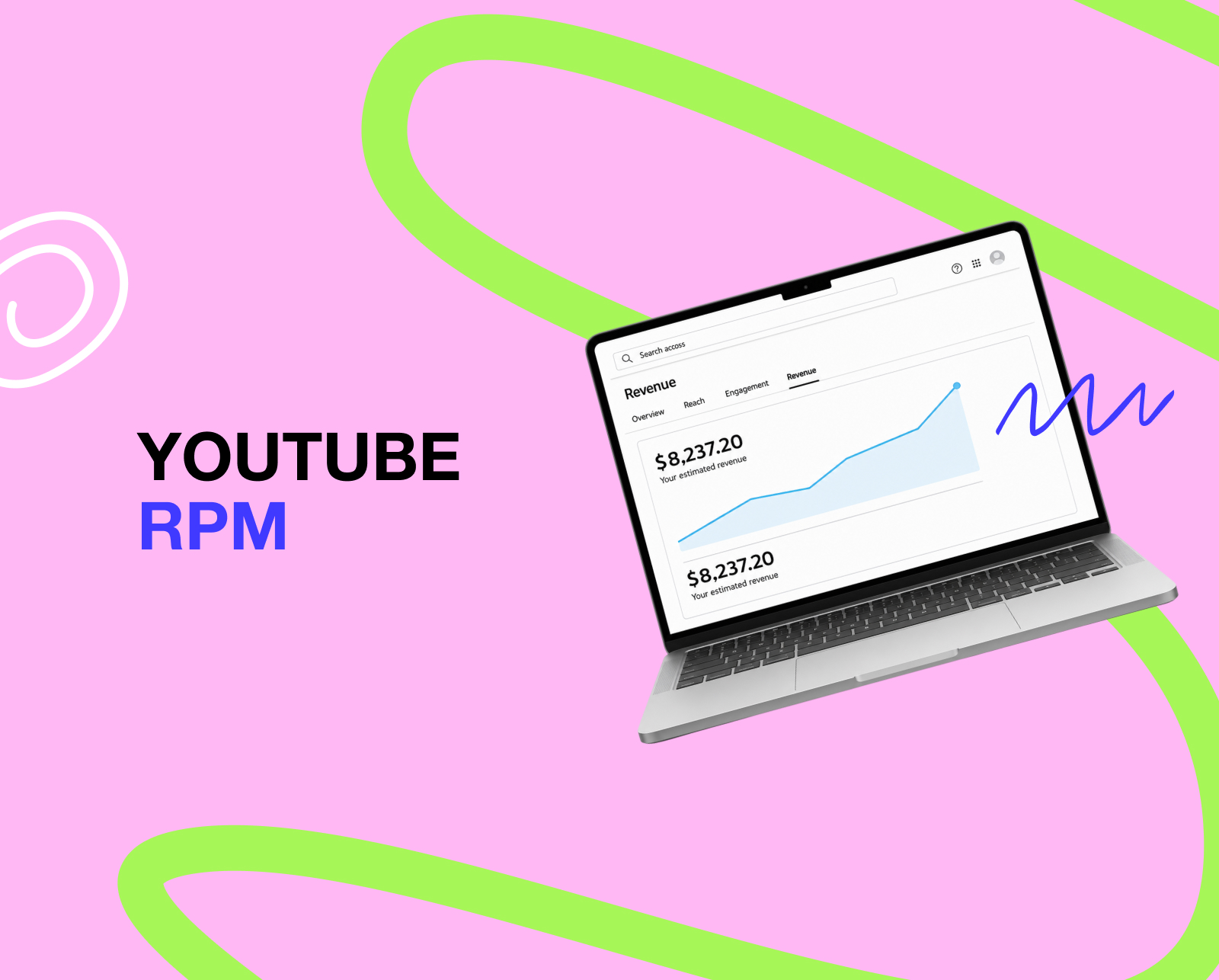
If you have monetized your YouTube channel, then you know that one of the most helpful metrics for getting your channel to grow and understanding how efficiently your content is generating revenue is RPM (Revenue per Mille). Unlike views or subscribers, RPM directly links your audience to your actual earnings. It shows how much creators earn, after YouTube gets its share, for every 1,000 views across the revenue sources reported in YouTube Analytics. But RPM is not a fixed YouTube pay rate.
In this guide, we will answer what YouTube RPM means for creators today and how it differs from CPM, what generally influences it, and how you can influence it back. This – and much more!
What Is RPM on YouTube?
RPM stands for Revenue Per Mille, or revenue per 1,000 views, and its basic formula is:
RPM = (Estimated revenue / Total views) x 1,000
For example, if a channel generates $600 from 200,000 views:
($600 / 200,000) x 1,000 = $3 RPM
That means the channel earned an average of $3 for every1,000 views. Crucially, RPM is different from what an advertiser pays for your audience (CPM). High YouTube CPM indicates valuable audience demographics for advertisers. It is a creator-side metric based on the views that appear in Analytics, after YouTube gets its revenue share. What takes Shorts, RPM is calculated per 1,000 engagedviews.
RPM can consist of:
- Watch Page advertising revenue
- YouTube Premium revenue
- Channel memberships
- Super Chat
- Super Stickers
YouTube's revenue reports also allow creators to break earnings down by Shorts Feed Ads, connected stores, and Shopping affiliates. Why is it important to know? Because with the same amount of views, you can earn more if, for example, your Super Chat revenue increases.
This makes RPM especially useful for analyzing your own content over time. Two videos with fairly similar views but wildly different RPMs can indicate areas to improve your monetization strategy.
Pro tip: RPM doesn’t reflect your total business. It doesn’t include things like affiliate commissions, external donations, sponsorships, or merch revenue. So always pay attention to other ways of increasing your profit and control the quality of your SEO parameters.
RPM and CPM: What's the Difference?
People often mix up CPM and RPM mostly because they both use the phrase "per thousand". But they measure different things that lie in the same plane. Businesses pay a set amount for every 1,000 times their ad is shown in a video on YouTube. This is called CPM.
YouTube RPM includes what the creator makes for every 1,000 views after YouTube takes its cut of the revenue and all the revenue sources that show up in YouTube Analytics.
| **Factor** | **RPM** | **CPM** |
| **Perspective** | Creator | Advertiser |
| **Measure** | Revenue per 1,000 views | Cost per 1,000 ad impressions |
| **Revenue source** | YouTube revenue sources (ads, YouTube Premium, etc.) | Ads and YouTube Premium |
| **YouTube revenue share** | Yes | No |
| **Non-monetized views** | Included | Not included |
The link between the number of views and the money you make on YouTube is shown by RPM (meaning YouTube calculates and then shows you only some of the views out of 100,000, because not all are going to be monetized).
YouTube also tells the difference between CPM and playback-based CPM. Playback-based CPM is the advertiser's cost for 1,000 playbacks in which ads were shown. These metrics help analyze how much advertising demand there is, but RPM is generally a better way to judge how well you're performing.
How to Check Your YouTube RPM
If you have access to the relevant ad revenue analytics on your channel, you can find RPM directly in YouTube Studio:
YouTube Studio → Analytics → Revenue tab
From here, you can see how your revenue is performing and compare different time periods, videos, and sources of revenue. YouTube also offers revenue reports at the content level, so creators can see which videos, Shorts, and live streams bring the most money.
Don’t judge RPM off of one day or one viral video. Instead compare:
- periods of 30 and 90 days;
- long-form vs short-form;
- different sources of traffic;
- audience geography;
- sources of revenue.
That gives you a much better understanding of what is driving monetization. To see estimatedrealistic numbers of how much your channel can earn, you can use a YouTube RPM calculator.
What Is a Good YouTube RPM?
There is no one universal "good RPM" for YouTube. This is one of the things many online guides oversimplify. YouTube doesn't tell us the average RPM by a niche, country, or channel size. Some benchmarks can be used as directional estimatesonly.
For example, recent third-party estimates frequently place average YouTube RPM in the 1-6 range across many channels for long-form videos. But finance, business, software, and other commercially valuable topics often achieve much higher levels. Entertainment and gaming tend to be lower, but individual channels can vary a lot. A $3 RPM may be good for one channel and bad for another, that is. RPM can be forecasted from projected view counts to estimate monthly income.
What Affects YouTube RPM?

There are several factors that influence how your RPM forms.
1. Audience geography
From market to market, advertiser demand can vary very differently. A channel that gets a lot of views in markets where advertisers are fighting hard for attention might make more money per monetized view than a channel that gets about the same number of views but mostly in markets where advertisers aren't interested as much. This is the reason why two channels with the same content and number of views can have very different RPMs.
But YouTube creators can't just pick a country with a high RPM and expect their RPM to change. Where your fans are is more important than where you live. Instead of trying to change geography, make quality content that naturally draws in the people you want to attract.
2. Niche & audience intent
Not all YouTube niches are equally interesting for advertisers. See, for an advertiser, someone watching a video about business software, tech, investment, and like is a good opportunity to earn. By definition, those niches are profitable. In this regard, when they are related to real estate, business, and so on, RPM will be correspondingly high.
Sure, it's always nice to know how much YouTube pays for 1 million views, but some niche topics also bring in enough money even with low view counts, because they are watched by people who are willing to pay and very interested.
At the same time, niche itself doesn’t define its RPM. There are many cases where a finance channel with a global audience earns less than a small channel of the same niche that reaches people in high-value advertising markets. Of course, you still need to monitor YouTube click-through rates and create interesting thumbnails, but focus on what you offer users in the first few seconds.
3. Content format & video length
Long-form videos have a totally different monetization system than Shorts. Videos over 8 minutes can include mid-roll ad breaks, giving creators additional opportunities to monetize a viewing session.
But just saying: to extend a video to hit the 8-minute mark is not a good RPM strategy. Including undesirable sections might reduce audience retention, and the additional advertising opportunity may not be worth the viewing experience of worse quality.
Make the length appropriate to the topic → keep the retention → use relevant ad opportunities, not constant multiple ad breaks. Revenue optimization should not come at the cost of content quality.
4. Non-monetized & monetized views
Not every view generates ad revenue. A viewer can watch a video without an ad. The availability of ads, viewer characteristics, advertiser targeting, content eligibility, and other factors affect whether a particular playback generates advertising revenue. And therefore, the more non-monetized views there are, the more RPM can be pushed down.
This is the reason for a peculiar phenomenon: your revenue can go up while your RPM goes down. For example, if your views increased by 100%, and your revenue increased by 50%, your total earnings have increased, but your revenue per 1,000 views has decreased.
5. Seasonality factor
Throughout the year, ad budgets change. During busy shopping times and holidays, demand is often the highest. But January can be different because that's when marketers start to do all new planning again after the end-of-year advertising. Even if you haven't changed your content approach, RPM can go up and down. If your channel's views drop in January, don't think it's because of you right away. Compare similar cases of different years to each other.
6. Revenue sources
When you find other ways to make money from YouTube, you can affect RPM. For example, a channel with a strong fanbase can earn from Channel memberships, Super Chat, and Super Stickers.


Learn more
Want to Grow Faster on YouTube? Get a free channel audit from Mediacube experts. Identify what’s holding you back and receive a clear action plan to boost your growth. [Get a Free Audit](https://mediacube.io/form?page=&form=welcome)
[Get a Free Audit](https://mediacube.io/form?page=&form=welcome)YouTube Shorts RPM vs Long-Form RPM
It’d be wrong to compare long formats and Shorts and their RPM. As we said before, for Shorts, RPM is calculated based on 1,000 engaged views, which is the metric for Shorts ad revenue sharing.
Their monetization models differ too. There are no familiar pre-roll or mid-roll, overlay ad placements in Shorts, they only appear between Shorts, and then actual revenue is split between creators. Obviously, RPM here is much lower than the one for long formats.
Although short formats vary greatly in their content and audience, we can see via third-party creator data that there are only around a few cents per 1,000 engaged views. But again, it doesn’t immediately mean it’s unprofitable to earn with Shorts. Those videos are useful for:
- Audience attraction & attention
- Discoverability
- Testing ideas, formats, trends
- Building a subscriber base and fanbase
- Cross-promotion
- Providing opportunities for sponsorships and brand deals
There are plenty of opportunities, but just don’t be fooled by the idea that those two formats function the same way.
How to Increase Your YouTube RPM
There is no button that promises a higher RPM. But the best thing is to improve the variables you can control. Here are some tips we can share:
- Analyze your top RPM content
Go to YouTube Studio and look for videos that have both: 1) strong revenue; 2) above-average RMP. Then look for trends and check the patterns. Are those videos long or short ones? Do they get viewers from other countries? Do they include commercial topics? Is their revenue made from Premium or memberships?
Your channel data is the primary benchmark and the most transparent picture of overall performance.
- Create content around high-value viewer intent
You don't need to change your niche completely. On the contrary, look for topics in your current niche that solve an expensive or commercially important problem.
For example, a technology channel can evolve from generic product news to software comparisons, buying guides, productivity methodologies, or advice on professional workflows. And the main goal is to bring in the audience that is valuable for advertisers and brands.
- Be mindful of using your mid-rolls
If your videos fit for mid-roll ads, do it if it doesn’t spoil the experience for the viewer. You can manually insert ad breaks around natural breaks instead of butchering the best parts of the video. More ad spaces don’t necessarily mean more money when the audience reacts rather negatively.
And yet, enable all available ad formats to maximize revenue per view, if possible.
- Make people stay
Retention affects how many people stay watching your content long enough to find other ways to make money. Apart from obvious advice like clear hooks in the beginning, consider, for example:
- getting rid of long intros,
- keeping strong pacing,
- no repetitive fillers,
- jumping to the promised value quicker.
Short or long, your video will bring more money when it’s able to hold attention.
- Find other ways to make money on YouTube
Since RPM offers many ways for creators to make money on YouTube, you can go beyond earning from ads only. Qualified creators can boost that by adding features like memberships, Super Chat, and Super Stickers.
Things such as affiliate marketing, sponsorships, merch, and services can become a lot more important as a channel grows.
Should You Choose a YouTube Niche Based on RPM?
Of course, you can’t go and choose a niche based on where RPM’s higher. It can be among the factors influencing your decision, but not the main one. A high-RPM niche won’t promise you a successful channel. You still have to have:
- enough audience demand;
- expertise or a reliable point of view;
- solid content production;
- competitiveness;
- strong retention;
- a realistic path to audience growth.
Remember that all those ‘high’ RPM numbers stay only theoretical until you can create steady, interesting content that attracts new audiences.
Watching Trends in YouTube RPM
YouTube’s monetization ecosystem is quite big and versatile. In August 2026, YouTube announced more changes to the YouTube Partner Program set to take effect from 1 February 2027, including new approaches to Shorts revenue eligibility and a new threshold for new applicants.
The bigger message for creators is that ad revenue is just one piece of the monetization puzzle. Instead of chasing a vague “good RPM”, use YouTube Studio to identify which content generates significantly stronger combinations of views, revenue, and RPM. Creators need to look at RPM in addition to total revenue, revenue by source, audience geography, content format, and revenue streams outside of YouTube. There are plenty of opportunities, just don’t panic.
And in this creative and pretty fast-moving world, Mediacube can be a perfect guide for you. We use our experience of working with thousands of creators to improve the quality of their creative work and to ease their path to growth. Jump in, we have plenty of space for you!