The eternal question of YouTubers would sound like this: when is the best time to post on YouTube? At first glance, it's pretty obvious, right? Just stick to what all those marketing blogs say. You know, create a viral video and publish on Friday afternoon, or give it a go in the evening. But let’s be real, the world of YouTube 2026 isn’t so straightforward. The YouTube algorithm is a bit more complicated. What it does is take a look at how your viewers react to your content in those first few hours and days after you post it.
The algorithm is looking at a range of different signals: how many clicks you’re getting, how well viewers are sticking around to watch, and how much people are engaging with what you’re sharing. So, if your viewers happen to be active at the time you upload, these signals are going to pop up a lot faster and be a lot stronger.
So to help make sense of all this, we took a good look at some big data from creators, industry research, and some publishing patterns on over a million YouTube videos. In this guide, we’ll lay out whether posting time means anything to the algorithm, what all the important signals mean and say, and how you can figure out the best publishing hours for your own audience. Instead of just following some generic tips and tricks, you’ll learn how to think about uploading as part of your YouTube monetization strategy that’s based on real data.
Does Posting Time Really Matter on YouTube?
To put it shortly, yes, it does. But not in the way you might have thought. Unlike other platforms where being the first in line and getting more views are a priority, YouTube's recommendation system aims at making viewers happy. The algorithm is designed to create content that is interesting and satisfying, no matter when it was uploaded.
But timing still has an impact on when the video starts earning. To see why this is the case, let’s take a look at how YouTube figures out if a video is any good.
You Know that The First 24 Hours Are a Trial Run
The 24 hours after you publish can make a difference for new videos. When you upload the video, it doesn’t immediately appear in people’s feeds. Instead, the platform “tries out” the clip with a few different audiences and keeps an eye on many different performance signals. Those are:
- Click-through rate (CTR) — how many people actually click on the video after seeing the thumbnail and title;
- Average view duration (AVD) and watch time — how long they watch on average;
- Engagement — how many likes, comments, and shares the video gets;
- Viewers’ satisfaction signals — whether they go and watch your other content.
The Creator Insider team has said that the system is much more interested in how people respond to the video rather than when it was uploaded. So even if you upload a video at a weird hour, it still has a chance to do well. But the moment you put the video live decides who gets to see it first. And that’s where timing starts to become more important.
If your video gets a lot of clicks, watch time, and engagement in those first few hours, the algorithm is more likely to recommend it to even more people. But if the engagement is weak, even if your content is great, your video might struggle to get going. Early views matter. Timing affects the rest of the impression. Here’s an example.
Imagine posting your new video when you know your audience is going to bed for the night. Your most loyal fans, the ones most likely to watch, like, and comment, might not see the video until many hours later. As a result, it’s likely to get weaker signals than it could otherwise.
The Best Day to Post on YouTube (Based on 1M Video Analysis)
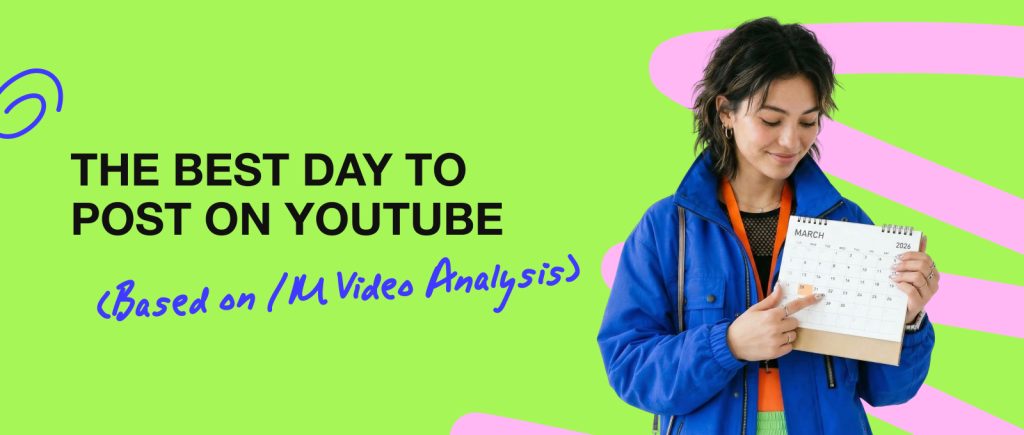
While YouTube doesn’t have a magic “perfect hour” that works for everyone, large-scale data from different sources digs up some pretty clear patterns in how people tend to watch videos. Across studies from all these analytics platforms and creator networks, plus some serious insights gained from looking at more than 1 million videos, we found out that there are several time slots that stand out for strong early engagement. Now, these patterns are largely influenced by the way people live their daily lives, which heavily depend on work schedules, weekends, and so on.
Below you’ll find a general rundown of the most successful posting windows that we’ve seen across many YouTube channels.
| Day | Recommended Posting Time |
| Monday | 3 PM – 5 PM |
| Tuesday | 2 PM – 4 PM |
| Wednesday | 3 PM – 5 PM |
| Thursday | 12 PM – 3 PM |
| Friday | 12 PM – 4 PM |
| Saturday | 9 AM – 11 AM |
| Sunday | 9 AM – 12 AM |
These slots aren’t random. They reflect what people usually do and when during peak viewing hours all around the world.
Do Shorts differ from regular long-form videos?
Is there a difference between posting Shorts and long videos? YouTube Shorts posting can be a bit easier than for full-length videos. It doesn’t rely on just subscribers to be seen. Of course, putting up a video at the right time can still affect how quickly you get your first few likes and comments. A lot of creators seem to do well by posting Shorts on YouTube during the usual lunch break time, afterwards when everyone’s getting home from work, or later in the evening when people are just mindlessly scrolling through their phone.
Because Shorts are designed with mobile phone use in mind, people watch them when they have a spare minute here and there, when they’re waiting for something, or just relaxing in the evening. Still, posting when many people are on their phones increases the chances of getting a fast response, which, in turn, means it's more likely to get your video out to more people.
We’ve also noticed that:
- Evening engagement on YouTube tends to peak during the workweek
During the weekdays, you tend to see a rise in YouTube usage come late afternoon and evening. Viewers usually start browsing the platform after they're done with work, school, or other daily tasks they have. So, publishing content a few hours before the peak viewing time lets videos start racking up engagement right when the audience is starting to be active.
Uploading between 2 – 4 PM gives the algorithm enough time to get to know the video and start testing it before the evening traffic. And when viewers start actively browsing YouTube around dinnertime or a bit later in the evening, the video is already in a good position to get some impressions.
- Weekend viewing time varies
Weekends work a bit differently. Instead of the evening peak times, viewing activity often starts a bit earlier in the day. People seem to open up YouTube in the morning, when they’re chilling at home, catching up on their subscriptions, or looking for something to watch.
As a result, Saturday and Sunday mornings tend to turn in some strong performances for a lot of channels. Publishing between 9 – 11 AM lets videos show up in the recommendation feeds and subscriptions as the weekend browsing sessions get going.
- Content categories vary in different posting windows
Another thing a lot of creators miss is that the different types of content attract viewers at different parts of the day.
- Educational and tutorial-type content shows good performance during weekday afternoons. Students, professionals, and people with hobbies often search for instructional videos during work breaks or study sessions.
- Business and marketing channels see stronger engagement during the middle of the workweek, especially from Tuesday to Thursday. Viewers who are looking for industry insights or professional content are more active during work hours rather than late at night.
- Entertainment-focused channels do best with evening publishing windows. Comedy, commentary, and reaction videos often line up with viewers’ relaxation time after work or school, when people are looking for something casual to watch.
The point is, timing strategies should fit the viewing habits of your specific audience and the type of content you make.

How to Find the Best Time for Your Channel
Every YouTube audience behaves differently in ways that depend on things like where they live, what they're into, and the kind of content they like. For instance, a gaming channel that targets people in North America might see most of their activity in the evening, whereas a channel that creates educational content and has an audience all around the world might see its viewers coming online at random points throughout the day.
It makes sense that the most reliable way to figure out when to publish is to take a closer look at how your viewers behave and try out different periods to see what works. Below are 3 practical steps you can follow to identify the best upload schedule for yourself.
Step 1: Check your YouTube Analytics
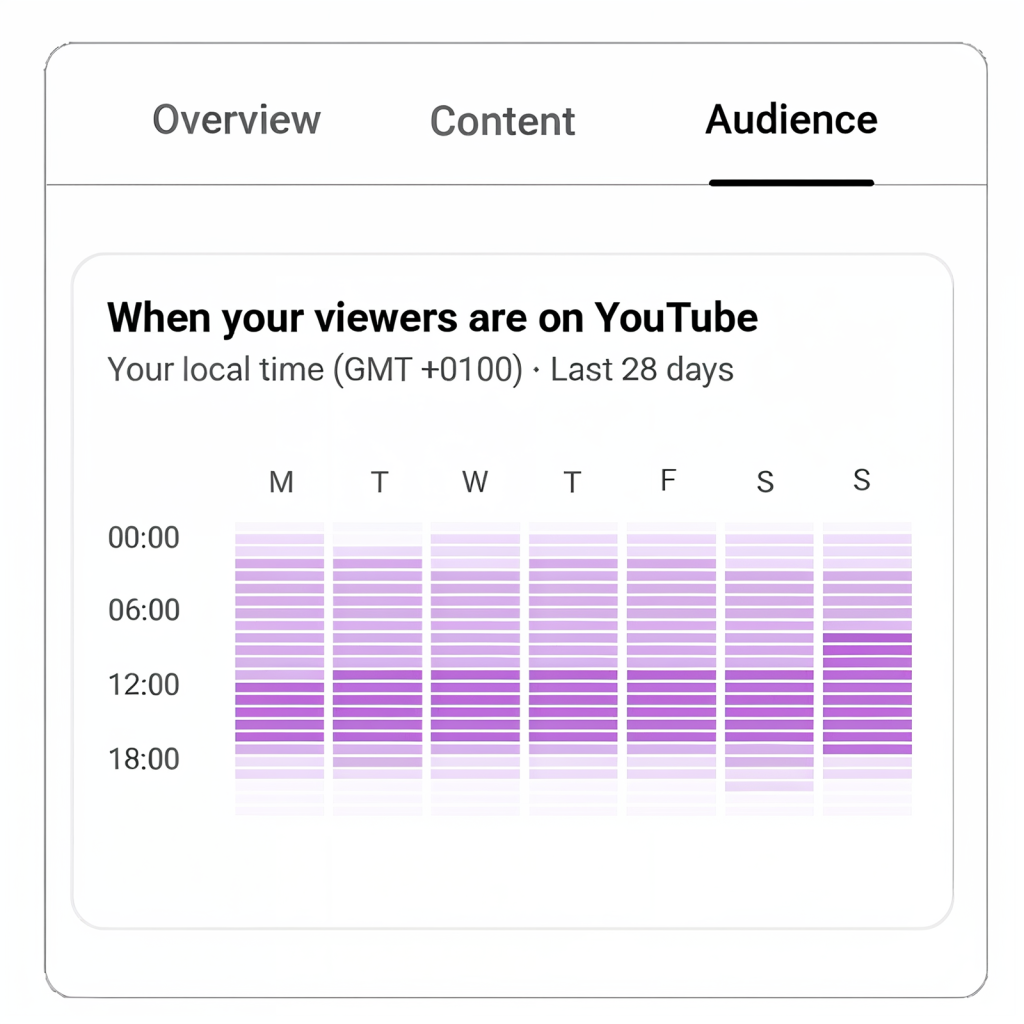
A good place to start is the Audience section in YouTube Analytics. Here, inside your Creator Studio, YouTube lets you use a feature called “When your viewers are on YouTube”. This chart tells you when your audience is online the most, and when they come to the site. Rather than making a guess about when you should go live, you can use this chart to schedule your posts at the times when your viewers are already active.
If the chart shows that your viewers are active in the evening, for instance, then posting a bit earlier in the day can be a good way to make sure your video is indexed and ready for recommendations by the time your viewers start coming online. If, on the other hand, your viewers are online at midday, then publishing a bit earlier in the morning might do the trick too.
The data is especially valuable if you have an international audience. Even a small change in time zones can make a difference in what works best. The same goes for many other useful metrics like Age and Gender, Geo, Subtitle and CC Languages, and so on.
Step 2: Run an experiment
Analytics are great, but they can only tell you so much. A bit of experimentation can bring things into focus for you! Let’s say you want to test out a few different times to see which one does the best. A simple 4-week experiment is a good place to start. For example, you might try:
- Week 1 — upload at 12 PM
- Week 2 — upload at 3 PM
- Week 3 — upload at 6 PM
- Week 4 — upload at 9 PM
After each post, take a close look at key metrics within the first 24 hours. If you notice that one particular time is consistently doing better, then this is probably the time when your viewers are most likely to be online and checking out your new content.
Step 3: Analyze your audience geography
Where your viewers are located is another important thing to think about when it comes to your upload schedule. If you have an international audience, then you may need to pick a time that works for multiple regions. For example, if you’re targeting people in both North America and Europe, then you might want to upload a video in the afternoon to catch both regions when they’re most active.
If you have a local audience, then you can optimize your schedule a bit more precisely. If you're targeting a US-only audience, you might want to focus on posting in the afternoon when most of your viewers are online. Channels targeting Asian markets might do best in the morning or early afternoon.
In reality, the best channels just combine all three approaches: analytics insights, controlled experiments, and geographic data to build a posting schedule that supports stronger engagement from the start. For creators working with partner networks or analytics services, additional performance insights can give you an edge by letting you compare your data with the broader industry.
Common Posting Time Mistakes Creators Make
A lot of creators who are making great content are actually sabotaging their chances to go big by making some pretty simple mistakes when it comes to their scheduling. Even if your video is great, it can still struggle to get noticed if you’re not publishing at a time that makes sense for your audience, and to be honest, many creators do that. Below are some of the most common mistakes you make when choosing when to upload your videos.
- Uploading a video without a consistent schedule or changing a schedule
One of the biggest mistakes that many creators make is just uploading whenever they’re finished with a video. So one week it goes up in the morning, the next week it goes up at midnight. This might seem harmless, but the truth is, this makes it hard for viewers to get into a routine of checking for new content. If you change your publishing time so often, it’s going to be impossible to figure out whether performance changes are because of the timing, or the topic you’re using, or just some random variation in viewer behaviour.
Viewers who keep coming back often have a certain time that they expect new videos. But when they don’t turn up at all hours of the day, a bit of the audience is going to miss the initial release, and that can influence engagement, like comments and watch time. Sticking to a regular schedule, on the other hand, helps your audience know when to expect new content. It also helps the YouTube algorithm see a stable pattern of performance from you.
- Not thinking about audience geography
Another pretty common issue is not considering where your viewers are actually from.
A lot of channels have viewers all over the world, but then they stick to their local time zone and end up publishing at times when nobody is watching. For example, if you publish a clip at midnight in Europe, that means most of your North American viewers will see it when they’re at work.
Paying attention to the geography of your viewers is important, especially if you’re planning to expand it and you need to deal with localizing your content.
- Publishing in the dead of night
A lot of creators think that publishing at midnight is a good idea because it gives the algorithm more time to get to the video. The reality is, though, that if most of your audience is asleep when it goes live, those first engagement signals are just going to be weak. As a result, the video is just going to struggle to get that early momentum going when it’s so important.
Publishing a bit earlier in the day, especially before the main viewing hours, means your video will start getting engagement rolling in right away as the viewers start to wake up.
For many creators, spotting where things go wrong isn’t always an obvious process. This is why they end up relying on extra help. By teaming up with CPS like Mediacube, you can get a better look at how your channel is doing and check your strategy for what’s working and what’s not. Also, we help adjust your posting schedules and avoid some of the most common mistakes.
Frequently Asked Questions on the Best Time to Post on YouTube
We gathered the most important information you need to know to find your own best time for posting content on your YouTube channel in those 5 q&a’s. Remember that there is no one universal solution for everyone as it all depends on your audience, geography, and other factors.
Much research suggests that weekday afternoons (2 to 5 PM) and weekend mornings (9 to 12 PM) tend to do pretty well. Videos get good early engagement before the main rush of viewers comes online. But the truth is, it all depends on who your audience is and when they actually watch your content.
Yes, it does! Of course, posting at the right time isn’t a magical thing for getting your video to rank higher. That’s ultimately down to what viewers think of your content. The algorithm focuses on things like watch time, click-through rate, and how engaged viewers are. But getting your video out when people are active can give it a boost, which makes it more likely to be recommended.
It’s very advisable to do so. Consistency is generally a good idea. Uploading at a set time each week helps viewers expect new content, makes a habit out of it, and tends to bring in more engagement. That said, the occasional change of plans is fine, but having a regular schedule leads to better, more stable results.
It’s not that simple. Both can work really well, depending on what kind of content you’re posting. Weekdays get a lot of love in the afternoons and evenings, while weekends tend to have more activity in the morning and early afternoon.
It varies for everyone, but some videos get views within hours, while others take days, weeks, or even longer to start getting results. The algorithm is always keeping an eye on viewer response, so strong engagement can lead to even more recommendations over time.
Stop Guessing Your Upload Time on YouTube
For many video creators, the question of when to publish a video can feel like a wild guess. In reality, there’s no magic hour that works for every creator. The way people behave, watch, and engage with videos varies depending on where they are, what kind of content they’re interested in, and when they have time to watch.
By taking the time to really understand your audience, testing out different periods, and sticking to a consistent schedule, you can slowly work out when the timing is right to get the strongest response from their viewers. In the end, the best time to put a video up on YouTube is when your viewers are actually ready to watch it. When you're serving up great content to people who are already in the mood to watch, the algorithm gets the signals it needs to help your channel reach a wider audience.
By jumping on board with Mediacube, creators get the benefit of our team reading numbers based on the performance data from the channels we work with. This means you can get a much better understanding of your audience’s behaviour, what’s going on with your posting schedule, and where your growth opportunities lie. Having that kind of data-driven support makes it a lot easier to get the timing right on those uploads and build a steadier plan for long-term success on YouTube.