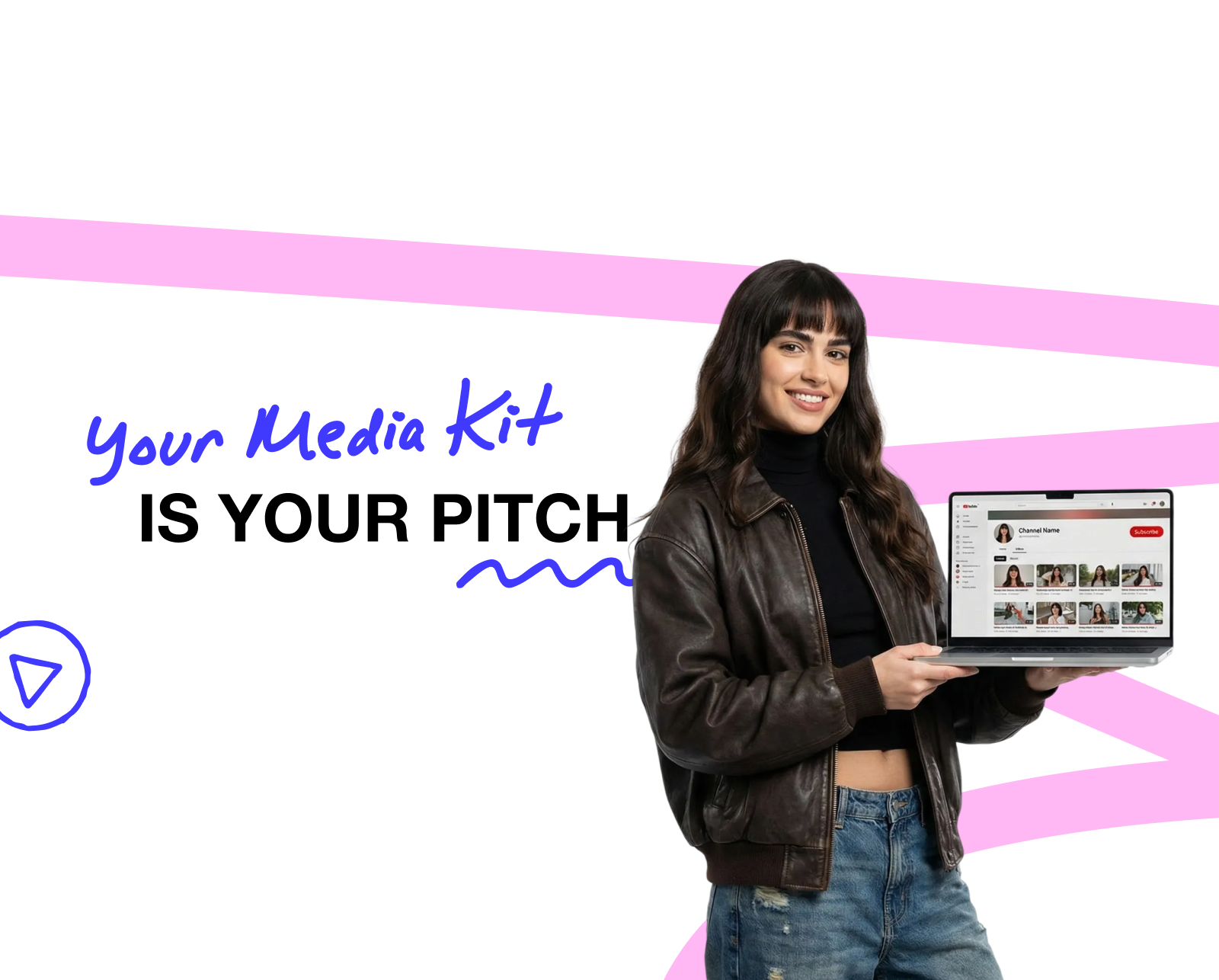
Every creator dreams of being noticed and getting big brand deals. The reality is that very few have a clear understanding of how to present themselves like serious business partners who, as experienced creators, are no strangers to various YouTube monetization strategies. That’s where a media kit really comes into the picture. The “kit” part here is for a reason. It’s a lifesaver for those creators who can easily pull it out of their sleeve and present themselves whenever.
Think of it as your personal showcase! You present a kind of business card that shows who you are, who your audience is, and why that brand should want to work with you. A personalized influencer media kit can make a huge difference in how many responses you get, how quickly you nail down a deal, and how credible you look to brands, especially when any other creator is sending random cold emails and invitations. Yet many creators get stuck on the same questions around a media kit.
So in this guide, you’ll find out what a media kit is really all about, what brands are expecting to see in an influencer media kit right now, how a YouTube media kit differs from other platforms, and how to create a cool effective one. Let’s dive right into the basics.
What Is a Media Kit and Why Every Creator Needs One
A media kit is a document that provides potential business partners with key information about your professional activities, audience, reach, and content performance, as well as opportunities to collaborate with brands. This is your statistics and creativity combined. Put simply, a media kit answers the question every brand is thinking: “Why should we work with you?”.
It’s a super useful tool that helps brands figure out whether your fans overlap with their target audience and whether you’re worth working with. With the creator economy growing so fast, brands are constantly getting attacked with collaboration requests. So it’s a regular practice for marketing teams to have to go through dozens of creator pitches every day, and because of the quantity of offers, they often make a decision super fast. Having a well put together media kit on hand really helps:
- Instantly builds trust — you look like you know what you’re doing and why you are here;
- Speeds up decision time — because all that key info is just in one place;
- Helps you stand out from the crowd — most creators still don’t have one of these things sorted, usually they rely on their name;
- Positions you as a reliable business partner;
- Presents your style and collaboration approach — that basically works both ways since brands also check whether you fit their brand ID.
Without a media kit on hand, brands end up having to spend more time looking for additional information, interviewing, and summing things up. More often than not, they just end up moving on to someone who already has it. And you definitely need this kit to collaborate and get your name out there, because among different YouTube channel monetization methods, this one is beneficial in more ways than one.
Media Kit vs Pitch Deck vs Portfolio
We noticed that many creators get these three mixed up, but they are all serving different purposes. So let’s be clear here.
1. Media Kit
a quick overview of your audience, what your numbers are like, and what kind of collaboration opportunities you offer. It’s usually the first thing brands will ask to see.
- A thought-through media kit can open doors for you
2. Pitch Deck
a custom-made proposal that’s been created for a specific brand campaign. It’ll often have some creative ideas and campaign strategy in there, too.
- The pitch deck is what seals the deal
3. Portfolio
a collection of all your past work: sponsored content, creative projects, and case studies. It shows what you can do and your unique style.
- A solid portfolio shows that you have credibility
What Brands Really Want to See in a Media Kit

There is a stereotype that brands just care about how big creators’ following is. In reality though, when a marketing team looks over a media kit, they are usually looking for something else: it’s not the numbers. It’s the activity of your audience. Are they active? Will they listen to you? In this regard, the question to the answer they will look for in any good creator’s media kit is “Will this creator help us get our message to the people we want to reach and bring actual results?”
In order to make that decision, they focus on a few key things.
1. A Good Engagement Rate
A high engagement rate is an indicator that your audience trusts you, pays attention, and is loyal. That is a pretty good predictor of the behaviour of your sponsored content.
Marketing teams look at the typical patterns that emerge over time, like the comments on your posts, how many people are participating in the conversation, and whether an audience keeps coming back to your channel. There are many cases where a smaller creator with an engaged audience is a safer bet and better choice in comparison with a bigger influencer, but with chaotic, mostly indifferent subscribers.
2. Solid Audience Demographics
Having a target market is everything. When you provide clear demographic insights, it helps them understand who they will actually be reaching. Things like age groups, geography, and their interests play a role in determining whether your audience is a good fit.
3. A Specific Niche
Covering many different, unrelated subjects looks uncontrolled and careless. When you have a clear direction with your content, it signals that you are an expert in what you do. It also gives a better understanding of how their product can be integrated into your creative ecosystem.
4. Brand Safety
Brand safety is no joke. It has become a necessary factor since the longevity and quality of the content matter, especially on YouTube. You should be transparent and consistent in your tone and the way you follow the rules.
5. Conversion Potential
Promotion and visibility go hand in hand with eventual results. So, it only makes sense that decision-makers are looking at indicators that show how the audience responds to recommendations. For example, it can include affiliate performances, past campaign results, click-through rates, and so much more.
Want to Grow Faster on YouTube?
Get a free channel audit from Mediacube experts. Identify what’s holding you back and receive a clear action plan to boost your growth.
Get a Free AuditCommon Mistakes to Recognize and Avoid
Even the most thought-through kit can still fail if it has some common mistakes. Let’s dissect them so you can avoid them. What can it be?
- Outdated statistics — using old data to support your pitch just makes your work unreliable;
- No clear sense of your value — telling what to do is not enough, you have to have a clear explanation of why brands would ever want to work with you;
- Chaotic, overabundant design — overloading your layout can result in losing the useful information among unnecessary details;
- Generic information — people won’t respond to the generic stuff that they probably have already seen millions of times, or to text that was obviously created by AI. Brands value personalization;
- Fake case studies — a dangerous move as it not only damages your credibility and reputation but also makes you look like a fraud. Companies are likely to check your background and information presented in the document.
These things might look obvious, but still, you can miss them and fall into the trap without realizing it. Don’t overcomplicate it and stay true to yourself, that way the marketing team will definitely appreciate the professional attitude.
Inside an Effective Media Kit
At the beginning of this article, we’ve already listed the main elements of any media kit. Remember, no one needs your biography and every deed. It must be a clear, readable overview of sorts. Let’s dive into it deeper and find out what exactly each point consists of.
- A creator’s personality — don’t focus on personal history, just highlight what makes you stand out as a creator. Here, for example, you can tell about your area of expertise, your audience preferences, and what makes your content different from others.
- Audience demographics — here you tell about your audience’s gender, age, region, interests and preferences, and also what type of content they prefer. In this section, charts are used heavily, since a visual answer to brands’ main question — can you reach our target audience? — is shown transparently.
- Performance metrics — these numbers show that you do have the audience, and they are engaged in what you do. Here you can add the average views, engagement rate, reach and impressions, watch time, and the frequency of your posting.
- Past collaborations — obviously, any experience is worth mentioning. It builds instant credibility and trust. Put your previous YouTube collaborations, logos of former partnerships, a review of what you did, necessary numbers, and feedback from partners.
- Final results, pricing, work formats — just describe what you can offer and at what cost. What formats you are good at, what your YouTube sponsorship rates are, and what options you can provide — all the key information people need to know to get an overall impression.
YouTube Media Kit: Not Like Other Platforms
YouTube differs from other social media platforms, like TikTok, Instagram, and others, and there’s a reason for that. Here, loyalty and content performance are measured differently. So when making a presentation as a YouTuber who treats their channel as a serious business and follows official YouTube partner program requirements for monetization, your media kit should reflect those differences from other platforms.
First and foremost, concentrate on your YouTube metrics. It has to include:
- Average views per video: are you reaching beyond your subscriber count?
- Watch time and retention rate: how consistent are your fans in watching your videos?
- Audience growth tendency: is there steady growth?
- Content category performance: which videos are the most popular: tutorials, sketches, reviews?
- Shorts and long-form videos performance: are different formats doing well?
Everyone’s Favourite Part: Audience Loyalty
Audience is one of the coolest parts about YouTube. A strong fanbase is a sight to see indeed. Don’t hesitate to show off if you’re doing great: your repeat viewer percentage, subscriber-to-view ratio, comment activity levels, and average watch duration.
Compared to other social media, YouTube focuses more on:
- Deeper analysis of metrics
- Storytelling
- Long-term audience engagement
- Safe environment
Just to set an example: if TikTok sets going viral as a priority — hype and being loud and recognized — then YouTube’s focus is on delivering, and delivering the content well, so that your viewers stay.
One more question to ask yourself: in what format to express yourself? There are several options, and each of them depends on what you want to achieve.
| One-page Media Kit | Multi-page Media Kit | PDF Format | Interactive Media Kit |
| Easy to make, quick to send and read. Perfect for cold pitches. | Suitable for when you work with many platforms and have many case studies. | The most common form that’s easy to share. | It’s your option if you want to include animation, videos, and clickable links. |
How to Make a Media Kit By-the-Book
The good news is that in order to create a good media kit, you need neither fancy software nor design skills. The only elements that matter are your relevance, accuracy, and being clear about your brand. In four simple steps, we’ll explain how to do it.
Step 1: Get Your Analytics in Order
Get your most recent performance data from the platform analytics. If you want to surprise your future partners with precise information, you have to include such metrics as:
- audience demographics,
- engagement rate,
- average views and reach,
- growth trends,
- content performance by category.
Of course, it may vary, depending on the platform you work with. But it’s extremely important to use only the latest numbers, like the last 30–90 days. Old data may influence your credibility badly and show that you treat your business carelessly.
Step 2: Figure Out Your Unique Selling Point
Before you move to designing a template, take a minute to figure out what sets you apart from the rest of the creators. Asking yourself these questions might help:
- What niche do you dominate, or what’s your area of expertise?
- What problems can you solve for brands, or what value do you offer?
- Who is your ideal audience, or who do you influence most, and how do you influence them?
- Why is your content unique? Maybe, you have an authentic approach, or cool editing skills, or charisma, or stylish outfits?
These key questions are the core of your media kit, and they answer the brands’ requirements.
Step 3: Design a Clear Layout for a Media Kit
Keep in mind: readability is more important than the prettiness of the layout. No super bright neon colors, no tiny fonts — get your message across clear and simple. Usually, it has this structure:
- a bit about you as a creator;
- who is your audience — age, geography, gender;
- the numbers — how many people are seeing your posts on different platforms;
- past collaborations you’ve done;
- what kind of YouTube sponsorship is available and what the rates are;
- how brands can get in touch with you.
Step 4: Customize Pitch for Each Brand
One of the not-so-obvious reasons why the pitch doesn’t work out is sending the same template to different companies. Please, don’t do that, don’t give in to the laziness. Instead, tailor your media kit slightly for each brand you’re pitching to.
An operative questionnaire for this part is:
- what industry is the brand in: can you speak to their specific needs?
- what are they trying to achieve with their campaign: can you help them meet their goals?
- who is their target audience: do you reach the same people?
Even the smallest act, like highlighting that part of your audience that is suitable for a brand’s target market, can make a significant difference in the whole negotiation process and increase your chances to get hired.
Free Tools for Creating a Media Kit You’ll Love to Present Yourself With
The information above is for the meaning behind a beautiful picture. But how to make one? Well, you don’t need to have a degree in design, you just need tools to use and your imagination. There are plenty of free ones to help you look pro.
Some of our favourites include:
- Canva provides templates to present a quick and nice layout;
- Google Slides is perfect for easy updates and easy adjustments;
- Adobe Express for some fancy branding, and it doesn’t demand a full subscription;
- Notion or similar interactive/clickable PDF tools for something are for the times when you are up to something a bit more dynamic;
- Figma is great for building a media kit from scratch and allows collaboration.
Using these tools, you can create a decent media kit that reflects your values, strengths, and achievements without making too many efforts.
Where Mediacube Stands Out as A Partner on the Way to Get That Deal
For those who are stuck on what data is actually relevant to brands, Mediacube has you covered! With our experience working with thousands of creators, we can give you the inside info on:
- what performance metrics impress sponsors in your field,
- how to present your analytics to get the best results,
- how to work with different offers and collabs,
- what brands are actually looking for in a media kit.
On top of that, Mediacube offers services and tools to make tracking your analytics easier and some expert advice to help you not only nail your positioning for brand collaborations, but also grow and keep getting inspired by opportunities that are there in plenty for you.

Frequently Asked Questions on Media Kit
We compiled a set of key Q&As that you need to know if you want to create a unique, authentic, and efficient media kit that will bring you new opportunities when done correctly.
A media kit for YouTube and other socials is a useful tool in the form of a document that contains the necessary information for brands, including who you are as a creator, your audience, and the ways you can work together.
You need to include all the information about your activities as a creator. If you make it for YouTube, add the metrics like watch time, average views per video, retention, etc. Present your milestones, key directions, and the form of the content you work with.
Absolutely! No matter how many or few followers you have, having a clear media kit just shows you’re a pro and ready to start partnering up with brands.
Yes, putting your starting rates or pricing rules helps brands immediately get what collaboration with you would cost.
PDF is the most common format that is accepted everywhere, but if you’re feeling you need more, go for an interactive format that makes people more engaged with your presentation.
Media Kit as a Necessary Tool in Your Toolkit
Today’s world is very competitive, and having a media kit can help you pave the way for your growth and success as a creator. It is an immediate introduction to who you are professionally, it proves your credibility, and makes the negotiations begin faster. Properly and thoroughly crafted influencer media kit does wonders for getting better quality brand partnerships and makes you look like a pro who knows what to do. And without a doubt, it will boost your reputation in the eyes of brands.
If you are serious about giving your channel a boost, making your analytics shine, and raising your chances of getting those partnerships, then Mediacube’s expertise is what you need to take your media kit — and your creator business — to the next level.