Having to deal with a Content ID claim on YouTube can feel like you’ve just committed a serious crime. The first reaction of any creator is a mix of anxiety and panic: Did I just break some rules? Am I going to lose all my monetization? Is my channel about to get banned?
But don’t you worry. Speaking from our experience, in most cases, you didn’t even do anything wrong, or, at least, nothing truly disastrous. And yes, it only shows that most creators don’t understand how YouTube Content ID works. That’s why you face misunderstanding, panic, and complications with monetization and rights once you get a copyright notice. But this notification of detected content is not a punishment. It’s an accessible tool for a dialogue between the rightsholders and the rest of the world. Don’t let your lack of understanding of how this tool works stay between you and getting your channel to grow big and properly monetized.
In this guide, we’ll take a closer look at how YouTube Content ID easily identifies and manages copyrighted content, why claims pop up, and, most importantly, how you can protect your revenue without limiting your creativity. All those issues were dissected together with Aleksandra Selyah, Head of CID and Aliaksandra Vakulchyk, Policy Implementation Manager.
What Is YouTube Content ID
At the heart of YouTube Content ID lies a digital system developed by Google that scans every single uploaded video and compares it against the database of copyrighted materials. It creates an ID file for copyrighted audio and video, which is stored in the database.
When it finds a match, YouTube kicks in an automatic claim. Usually, it's an owner's preferred policy. The keyword here is automatic. There’s no manual review at this detection stage, no human eye to approve the match, unfortunately. The technology relies on automatically scanned fingerprints to match content at a massive scale.
YouTube created Content ID as a tool which provides people with detailed analytics on where their content shows up. When a YouTube video is flagged by Content ID, the rightsholders can monetize it and receive ad revenue, block it from being seen, or just track how well it’s performing and do nothing more about it. As for content creators, that basically means this: you can’t make Content ID follow your whims, but if you follow the explicit guidelines set by YouTube and meet the requirements for monetization, you can fit into the system. Note that YouTube participates in the revenue share. It takes 20% of revenue from running ads in monetized videos, whereas owners get 80%.
Protect Your Content with Content ID
Get access to YouTube’s Content ID and expert support from Mediacube to handle claims, strikes, and copyright issues.
There is a common misconception that any creator can simply access YouTube Content ID. But the truth is, direct access is tightly restricted to people who can prove they own the rights to content on a large scale. So to be able to qualify, you need to:
- own the exclusive rights to the original content, no sharing with anyone else;
- be in control of distribution.Sometimes you can get regional rights, you need to see what assets you own;
- have some solid proof in the form of legit documentationto back your claims.
Essentially, Content ID is mainly used by the big players in the industry, like record labels, film and TV studios, and mass distributors and creators. Most people, though, only interact with this feature when (and if) they get a copyright claim. This is the reason the majority of claims are happening in the music business production, because Content ID is tightly linked with YouTube Music. That means even tiny bits of background audio can’t go unnoticed.
Essentially, Content ID reduces the need in having manual DMCA takedown notices and expensive legal cases. For small creators who also want to have their content protected, there is an opportunity to use this feature through third-party services, like Mediacube.
There are several reasons why YouTube keeps tightening the rules:
- more and more people are using/reusing materials and generating content with AI;
- rights holders are now more eager to fight for their copyright-protected content more aggressively;
- for YouTube, ensuring accurate and right monetization processes got even greater priority.
Automated Flow of Working Processes for YouTube Content ID System
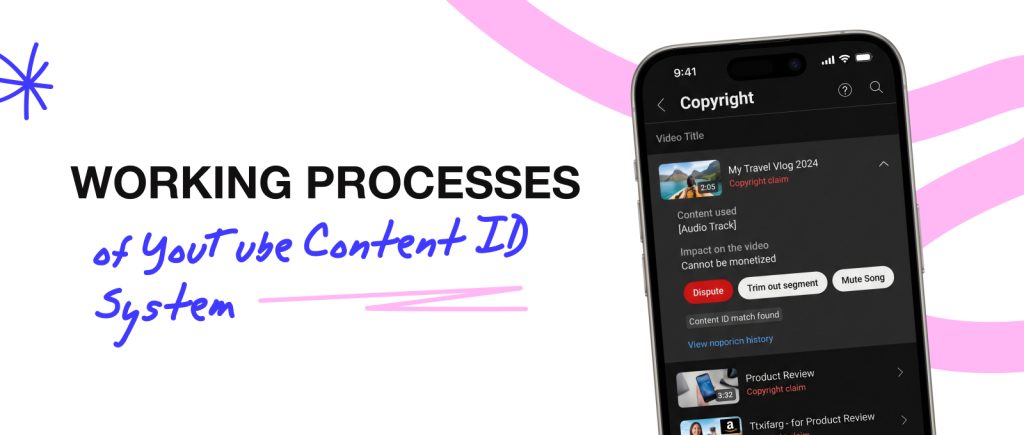
To get how the claims process works, try to view it as a whole system rather than a series of individual steps. Everything begins when the copyright owners upload and register their original content to YouTube’s database. These reference files become the benchmark against which detection is done. When a YouTube user uploads a video, YouTube checks it by scanning it using digital fingerprinting that lets it track down any matches.
Don’t confuse claims with strikes, though, since claims affect your video only, while strikes, as a legal action, can affect your channel as a whole.
What the System Actually Puts on the Radar
You can break it down into three main areas of focus:
- audio patterns, even when they’re modified or just in the background;
- visuals (like transition effects, scenes, and individual frames);
- short clips of video (in some cases, they’re just a few seconds long).
If it finds a match, a claim is automatically triggered. And as you see, there is no need for human intervention at this point. The rightsholder gets a say on what happens next, and here they have several options:
Action | What it means | Impact on creator |
Monetize | Ads run directly for a rightsholder | You lose revenue |
Block | Video is unavailable | No reach |
Track | Collected data to see a video performance | No impact |
…or do nothing! Yes, some people decide not to act on it at all. But it’s more of an exception rather than a rule.
What Happens After a Claim: 3R — Revenue, Reach, Risks
Once a claim is slapped on a YouTube video, what happens next? Its impact usually falls into three possible areas.
Revenue. In most cases, the ads are still running and showing up, but now the money from them is going straight to the owner of the matching content instead. There are instances where you might get a share of the ad revenue your video earns, but that all depends on the rightsholder's policy and what they decide to do. It works for any format, so if you monetize YouTube Shorts, for example, then you may face the same consequences.
Reachis next on the list of things that might be affected. Some claimed videos get completely blocked, while others get put behind regional restrictions. And even though this can all go quiet for a while, it can quietly strangle your channel’s growth if a serious amount of your viewers is affected.
Risksdepend on how you react to the claim. A single claim on its own isn’t gonna do a lot to your channel, but repeatedly getting hit with claims or disputing something that's a straight-up factual issue can escalate things significantly. Claims are not only one of the possible reasons for YouTube demonetization, but they can also lead to be blocked from viewing.
The nuance about timing is that rightsholders have a window to respond, and if no action is taken, YouTube applies a default policy. If a claimant doesn’t react, the claim expires.
Who Is Protected by Content ID: Mediacube’s Experience
As soon as you enable Content ID, your YouTube partner manager creates the content owner that gets you access to the necessary content manager tools in your YouTube Studio. Now the question is who is protected by this important system.
Mediacube Content ID Department helps creators and copyright holders to protect their content from illegal use. We are approached by both creators connected to Mediacube and those who need the Content ID tool as a separate service.
"Our solutions are suitable for different categories of content creators", including:
Original content creators
If you create quality and in-demand content, there is always a risk of it being illegally distributed. We help:
- Restrict access to copies and direct traffic to the original channel.
- Block infringers who distribute copyrighted material.
- Earn money from content in case of unauthorized use.
Game publishers
The game’s GUI and in-game elements are also subject to copyright. We provide publishers with tools to:
- Monitor compliance with the user and license agreement.
- Protect content from illegal distribution on video platforms.
Distributors of sports broadcasts
Sporting events require a lightning-fast response to copying. We protect content in real time by helping them claim rights to broadcasts right at the time of the event. Since 2024, more than 1,000,000 copies of our partners’ content have been protected with Mediacube Content ID. We keep working to ensure that your content remains well protected,” said Aleksandra Selyah.
We are also approached by the following categories of copyright holders for assistance with Content ID.
Music industry
Chances are that it was the music industry representatives, big labels like Universal Music, for example, that drove the need for using Content ID. Companies noticed that their intellectual property was being used more and more frequently and without regulation on the emerging service, hence the need to automate the process.
Creators who have been on YouTube for a while know how sensitive Content ID is to music snippets, so they keep out of trouble by using royalty-free tracks. Or you can create music for your videos yourself, but they must be 100% original and not contain samples from songs of other people. The good news is that YouTube allows you to delete audio from the video in the Video Manager if the user wants to keep monetizing a video.
Film and TV companies
Film and TV companies spend a lot of money to create their content, so they are rather sensitive about creators who base their work on reviews, compilations, and the like. Time after time, you hear them complain that fair use rules are constantly changing, but unfortunately, this is the reality of dealing with intellectual property.
Production centers
The rights to certain music tracks or videos do not always belong to their respective performer. Often the copyrights of creative works are owned by production centers and labels, which are also quite reverent about the enforcement of copyright protection.
Independent creators
There are tons of creators on YouTube whose popularity alone can get you views if you use them in your titles or thumbnails for your content. However, as you might have realized by now, any creative work posted on YouTube is copyrighted. Note that if you’re using clips of videos by famous creators, you could also get a strike from Content ID.
Why You’re Getting Content ID Claims
Most claims seem to arise from a group of recurring situations, though they are not as obvious as you might think. The most common things that trigger a complaint are:
- background music;
- background video — switch off the TV when you’re recording;
- snippets from a movie or TV show;
- random images or visuals that you found on the internet;
- stock footage that has ambiguous or super limited licenses;
- reaction videos.
One of the biggest myths around fair use is the idea that as long as you just stick some commentary on a clip, or add a bit of editing, then you’re automatically in the clear. Fair use is a legal defence, not a trump card. And it's worth remembering that Content ID doesn’t have the power to magically sort out legal issues for you just because you have it.
How to Dispute a Content ID Claim
Don’t go around disputing YouTube claims without a very good reason! You should only bother if you genuinely own the content, can prove you have a license to use it, and the usage of that content adds some value.
On the other hand, it's sensible to back down if the content looks very clearly copyrighted and you can’t argue a good reason for not needing a license to use it. So when you’ve been accused, you can either agree and accept the terms, delete the copyrighted part of the video, or try to explain your side of the story.
The mechanics are pretty simple:
- Go to the YouTube Studio
- Find the Copyright section
- Pick the video that’s been accused
- Click the “Dispute” button and give them your side of the story
- That's it, you'll then have to wait for the rightsholder to take a look at your reasons
When you work witha partner CSP, keep in mind that they can’t answer the claimin the dispute section. They either confirm, or withdraw it.
There are some scenarios where a claim falls on your head even though it isn’t even close to reality. So if you’re dealing with a so-called 'false claim', your best move is to get all your evidence ready, like proof of ownership, any relevant licenses, or copies of the original files. It's probably a good idea to have this stuff on hand when you’re dealing with a public domain claim, too. You’ll need to be prepared to show where the content came from, prove it is the public domain, and submit any other relevant paperwork that might be needed.
And then there are the grey area cases where someone just makes a claim on content that doesn't belong to them, and these are known as fraudulent claims. In these situations, you’d be best off having paperwork ready and using Content ID and all the reporting tools that YouTube has at hand to get the issue sorted.
Tips to Never Face Content ID Claims
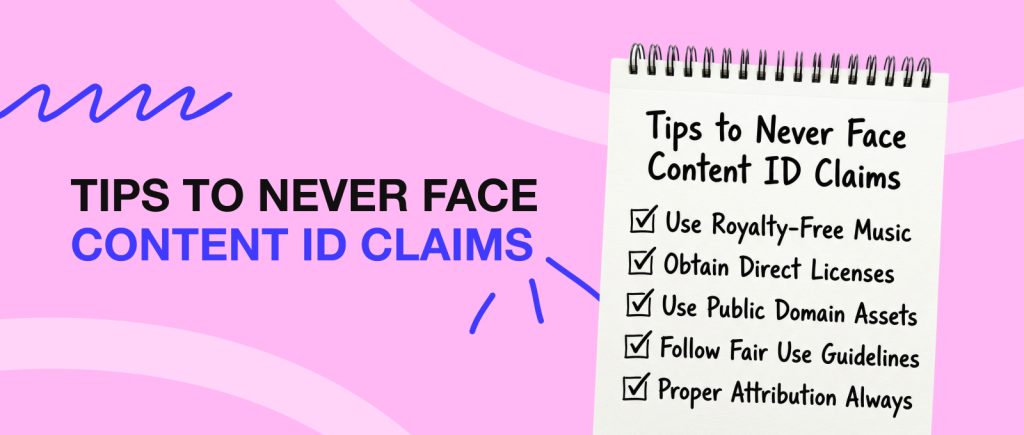
Choosing the right assets is your first move. Yes, music libraries and stock platforms will help avoid the trouble, but it’s just as important to do something with the materials creators opt for. Smart creators rework the materials they pick. They add some context, make some comments, give the thing a new shape or a story. That way, in the end, it transforms into their own work. Trimming a clip and slapping some subtitles on isn’t good enough. The system is sensitive, so the claim will still get through.
To avoid copyright claims on YouTube and overall getting into trouble, there are a few simple rules to keep in mind:
- Even if something’s labelled “royalty-free”, take a look at the license, because it might not cover YouTube or monetization, so you need to double-check;
- Try to avoid popular music that goes viral on social media, especially if you can’t prove where you picked it. If you got that composition from a licensed library, then that’s a different story;
- Keep all the receipts and docs. You might need them to sort out a dispute;
- Background music can be just as problematic. Music playing in the background in a cafe, gym, or public place can cause you a claim;
- Don’t think that short clips are safer than longer ones, or that giving credit to the author is enough. Unfortunately, it’s not.
Doing this will make your production process run like clockwork, and you’ll be able to scale up no problem. At the end of the day, avoiding Content ID issues is tied to planning everything beforehand.
Frequently Asked Questions on Content ID on YouTube
Check out the top-5 most common questions people usually ask when facing Content ID. Almost like in a flash poll, we give you only the necessary information.
Can I remove a Content ID claim without deleting the video?
Yes, you can dispute the claim or just cut out the specific bit of the video that triggered it.
Do claims affect my channel long-term?
Nope. Claims don't affect it, but they might reduce your profits.
Can I monetize a video with a claim?
In some cases! It all depends on the rightsholder. Money can stay with you or be redirected.
How long do disputes take?
Usually, it takes up to 30 days.
Can I use copyrighted content if I edit it?
It depends on what you did with the content. When it’s a fair use case, then yes.
Content ID is Not a Threat, But Be Responsible About It
Content ID exists for finding a balance between giving creators the freedom to express themselves and giving the owners of the copyrighted music they use a fair share. The YouTubers who make it big these days don't try to outsmart the system, they figure out how it works and make smart calls about what you can and can't get away with. They see copyright as a part of the game and know how to monetize their YouTube channel without getting in trouble.
If you approach Content ID with sound judgment and understanding, suddenly it stops being the source of nightmares and becomes something you can live with, and even use to your advantage when it comes to protecting your income.Creators who work with Mediacube take it to the next level: they get connected with safer ecosystems online, receive expert advice, withdraw YouTube money more conveniently, and, which is also very important, get help when someone inevitably tries to claim a snippet of the videos uploaded to YouTube as their own.