For anyone trying to be a successful creator on YouTube, demonetization is no joke. Any video can be stuck in a position where it can’t generate ad revenue, and understanding why it happens is crucial for preventing that from happening to your channel. As we’ve seen over the past 12 months, the rules have gotten stricter, and that means video content that’s passed checks in 2024 and 2025 is getting flagged for things the system can pick up on now, according to new guidelines. At the end of the day, that means a lot of creators are facing a drop in ad earnings, limited monetization features, or they just get kicked out of the YouTube Partner Program altogether for not following every letter of YouTube monetization rules and YouTube community guidelines.
Based on our experience at Mediacube, the sad fact is that demonetization is rarely just a random occurrence. More often than not, it happens due to typical patterns like a lack of unique content, reusing the same old format over and over, or structural problems throughout the entire channel.
Together with Olga Karpovich, Head of Channel Review, and Maria Gorbatovich, Channel Review Manager, we discussed what YouTube demonetization means, how YouTube AI's evaluates content in 2026, and what you can do to prevent or recover from it. This guide is for anyone building a channel on YouTube who wants to avoid having their revenue streams drop, sort out any issues that might come up while following YouTube monetization requirements, or recover if they’ve already been demonetized.
Before all that, you might want to check how your channel is doing with our YouTube monetization checker, which shows what still needs to be adjusted so that you can apply for the YPP and start making money.
Most Common Types of YouTube Demonetization We See
Before we dive into exploring the causes, let’s briefly face the types of demonetization and limit monetization because in all truth, not all of them are the same. The level of the overall problem and how you can fix it depend on those types.
Type | What it means | Who decides | Can it be fixed |
Limited monetization (yellow dollar sign) | Ads are restricted due to advertiser suitability concerns | Algorithm + sometimes manual review | Yes |
Ineligible monetization (red dollar sign) | Monetization is fully disabled for that particular video | Rightsholders | Yes, but with exceptions |
Channel demonetization | Ads disabled across all content | YouTube review team (policy team) | Difficult but possible |
Channel termination | The channel is fully removed due to severe or repeated violations of YouTube policies | YouTube Trust & Safety team | Very difficult, only via appeal |
Based on our experience and years of observation, we identified the following, most common reasons for a channel’s demonetization:
1. Inauthentic contentThe stuff that gets uploaded in tons or copied from other people without putting in any effort. All those low-quality videos that lack any real thought or creativity. This can be videos made using the same template with barely any changes, or YouTube videos that are quick and easy to produce in large numbers. Triggers include storytelling without a unique authorial contribution, repetitive thumbnails and titles, image slideshows without original video footage, a templated video structure, fully AI-generated low-quality voiceovers, and excessively frequent uploads.
Content is considered authentic when it is clearly original, creator-driven, and provides unique value through personal input, analysis, and presentation rather than repetitive, automated, or reused material.
2.Misleading family content (also known as Harmful content involving minors) Now, about high-risk formats. Some of them might have worked at scale just fine, but now get flagged consistently. Olga Karpovich says that “among other reasons, channels that aren’t aimed at a children’s audience but use characters in their YouTube videos that appeal to children, especially if they're horror characters, are in the high-risk zone.”
Typically includes videos that appear to be made for children or families but contain inappropriate, deceptive, or potentially harmful elements. This can include YouTube content that uses bright thumbnails, familiar cartoon characters, or child-friendly titles to attract a young audience, while actually featuring disturbing, violent, sexualized, or otherwise unsuitable themes. For example, demonetized videos may depict well-known kids’ characters in unsafe or adult situations, include hidden inappropriate jokes, or promote risky behaviors.
YouTube's advertiser-friendly content guidelines specify that triggers include scary characters and frightening imagery, depictions of blood, injuries, or bodily harm, adult themes presented through child-like visuals, misleading titles, a mismatch between visuals and meaning, a lack of clear meaning or educational value, and repetitive scenarios that may have a negative emotional impact.
3. Reused content****YouTube demonetize videos that just use loads of third-party material without doing anything to add at least a note of your personality. Triggers may include re-uploading other people’s videos without meaningful changes, using clips from movies, TV shows, or social media without adding original commentary or value, compiling content from multiple sources with little to no transformation, relying on stock footage or viral clips with minimal editing, and repurposing the same material across multiple videos with only slight variations.
Let's talk about the topics that are strictly prohibited if you want to avoid YouTube demonetization.
- Inappropriate language
- Violence
- Adult content
- Shocking content
- Harmful or dangerous acts
- Hateful and derogatory content, hate speech
- Recreational drugs and drug-related content
- Firearms-related content
- Controversial content issues
- Sensitive content and events
- Enabling dishonest behaviour, misleading metadata
- Inappropriate content for children and families
- Incendiary and demeaning
- Tobacco-related content
And then there are also infractions, like spamming, dodgy practices, and other things that can be interpreted as misleading. And that leads to more than just demonetization. It can get you completely shut down with a YouTube channel suspension. To avoid channel suspension for Spam, deceptive practices, and misleading contentand have your channel eligible, you need to focus on transparency, originality, and consistency between what you promise and what you deliver. Make sure your titles, thumbnails, and descriptions accurately reflect the actual content of your videos. Avoid clickbait, exaggerated claims, or anything that could mislead viewers into expecting something different from what they’ll see.
YouTube constantly polishes the way it polices things, improving the space for the better, nonetheless complicating the eligibility process for content creators. It happens through a combination of things, like pattern recognition across different videos, a semantic analysis of the scripts to see what’s really going on, and human reviewers who get called in when they spot something that looks fishy. Channels inactive for six months or more risk losing their monetization status according to YouTube policy.
If we’re talking about Shorts specifically, yes, they can also tank your YouTube channel if you’re not cautious. This is probably one of the biggest risks that people are underestimating! That said, Shorts aren’t treated like they’re separate from the rest of your channel. So, if you upload a mix of things to your channel including Shorts, live streams, community posts, descriptions, and private videos included, all of them can impact the way you’re earning ad revenue from your YouTube channel.s, and private videos included, all of them can impact the way you’re making money from your channel.
Reused Content vs Fair-Use Content: The #1 Demonetization Trigger
Here we explore one particular reason for demonetization that probably causes most of the issues. That’s why you need to understand the difference between reused and transformative content is the difference between copyright infringement and compliance to the guidelines. Reused means exploited content that doesn’t add anything new to the already existing sample. While you may avoid getting a copyright strike by following the rules for that one, you can still be demonetized if your videos don’t include any actual original contribution, change the meaning, or give any new insight.
Based on real channel reviews, we can highlight these cases:
- Reuploading videos as they are — content uploaded several times and from other platforms, like TikTok, Reels, etc.
- Compilations— “Best/Funny moments”, “Try not to laugh”, and so on.
- Brief personal opinion — short or no commentary, simple, generated subtitles, AI voiceover that states what’s happening on the screen.
- No semantic work — no analysis, reworking, or new perspective.
If you ever wondered if compilations ever pass, then the answer is yes. But they have to meet some strict conditions. You can’t just organize content, you need to transform it or explain it. Compilations can be monetized if they includeclear additional value, like:
- explaining what’s going on (e.g., breaking down why a knockout happened in that fight);
- narrative structure that turns clips into a real story;
- meaningful editing that changes the pace and adds context, creating an emotional arc;
- a unique voice or perspective without templatedAI narration.
Here we should add a quick note on why AI voiceover is not the same as the original content. You’re wrong if you believe that it is the same. Just as it is for the subtitles or the content of the video in general, when you just describe what is on the screen or use a repetitive script, you get flagged. You need either new info or your personal insight.
How YouTube Detects Farming Channels
Don’t fall under the impression that YouTube detection systems are simple and predictable. They are more advanced now, and based on what they observed, the platform flags suspicious content by identifying the following signals:
- Structural
- everything looks the same — from intro/outro to pacing and duration;
- each of your videos mirrors the previous one.
- Content
- reused scripts and topic;
- identical/very similar visuals.
- Behavioral
- producing lots of content;
- low views, high skip rates, and very little engagement.
AI Content on YouTube: How It Works
Is YouTube demonetizing AI videos instantly? AI generated content isn’t automatically demonetized on YouTube, but it is one of the most misunderstood and risky areas in the policies of the platform. So, you can use AI, but don’t expect to get away with it if there’s no human contribution in there.
YouTube’s way of evaluating AI content is based on how much creative input goes into it and what the creator intends to do with it. The YouTube systems don’t look for just the trail of AI tools used. Content is flagged as high-risk if:
- scripts are obviously AI and haven't been edited,
- a voiceover sounds repetitive and synthetic,
- visuals are either AI or just downloaded from a stock library and don’t make sense to the overall narrative,
- all your videos are following the same format — same formula, same music, same shots.
This is called the AI slop. These mass-produced videos don’t bring anything to the table, they exist simply for the sake of existing.
In Maria Gorbatovich’s opinion, “What’s important here is the human contribution to the content. For example, if it’s AI-generated text, the author reworks it, adding unique ideas and their own plot elements. If it’s a voiceover, it’s great if it’s based on the author’s own voice or if it’s a paid version of any AI tool. But still, you have to be very careful with using it, because you can’t predict what exact amount of AI is inappropriate for YouTube.”
That’s why we compiled several tips on how to use AI and be careful at the same time — even though it can’t be a 100% guarantee. They might seem to be obvious, but trust us, there are so many creators who still keep forgetting to follow these tips to keep the results as authentic as possible.
- When you write a script, rewrite it yourself, add the things that are your own markers, like specific words, for example.
- Do a voiceover, but then you have to edit it so that it sounds like you and has your tone of voice. There are AI tools that can be made on the basis of your voice.
- Always remember that AI-driven visuals are no more than blocks in your foundation, just additional elements, not the whole backbone.
- Stories can be generated, but then they must be edited by adding your ideas, your structuring, and your opinions.
All in all, it’s simple: if you have your hand in the process, ad revenue is available. But if the content relies solely on AI, then it’s a no-go.
Do AI disclaimers even matter? Absolutely yes, but not for the reasons that most creators think they do. In 2026, disclaimers are important only for being transparent, respecting your audience, and actually following the rules, especially when you could potentially mislead your viewers.
YouTube is particularly on the lookout for:
- misleading, repetitious content (Spam & Deceptive Practices);
- when you present realistic AI-generated videos and footage as real events;
- impersonation of someone else’s face or voice.
“Even if the creator has labeled the video “Created by AI,” but uses someone else's face or voice to deceive or mock a person (without indicating that it is a parody), the video will still be removed, and the channel will be demonetized,” shares Maria.
Harmful Content Involving Minors (HCIM): Why Kids’ Content Gets Demonetized
Content abouContent about and for kids is one of the places on YouTube where you get checked even more thoroughly. And it’s also a place where many misunderstandings arise. In 2026, YouTube expands what they consider to be Misleading Family Content. Basically, that’s just a new way of saying that even eligible videos that don’t technically break the rules can still lose access to ad revenue if they’re deemed to be emotionally distressing, confusing, or just simply not suitable for children.
Content can get flagged even when there’s no intention to cause any harm. It will likely be flagged if it includes things like:
- child-like characters getting into a creepy horror scenario,
- jumpscare visuals or some other kind of intense action that might spook kids,
- a HUGE disconnect in tone (cartoon characters in a grown-up setting),
- the same negative emotions repeated over and over,
- and no real point or value to the content.
And you know what’s even trickier to navigate? Channels that are definitely not for kids but still use characters that are too appealing to them. That potential zone of risk must be avoided by all means.
From what we’ve seen, creators often get themselves into trouble because they don't get how things work! For example, some creators choose not to pay attention to how that content lands with your younger audience. Or some of them believe that their video being violence-free means it's automatically safe.
So why do many appeals get shot down in this category? It’s because creators keep focusing on their good intent instead of the actual impactand how people are interpreting their content. YouTube doesn’t look at what the creator meant to do. They look at how your content looks and feels.
Don’t know how to distinguish high-risk from high-quality content? If it’s confusing, intense, full of repeated negative scenes, and overall doesn’t have a clear meaning, it’s high-risk. And if it’s clearly age-appropriate, engaging, and meaningful, you know that it’s high-quality.
YouTube Demonetization Appeal Process: What Works, What Fails, and How to Avoid
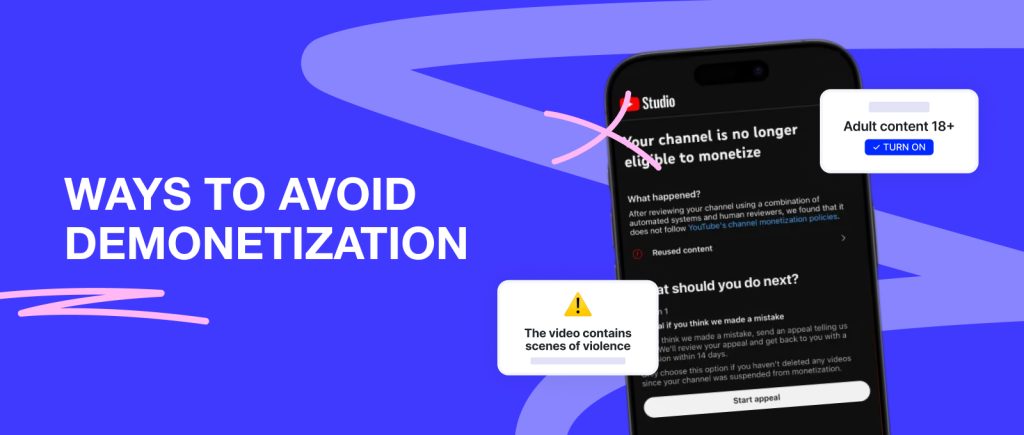
When a channel gets demonetized, the appeal process is critical. Based on our experience, YouTube typically creates a review window of up to 14 days, but usually comes back to creators with a response within 4-5 days. There are a few timing rules to be aware of:
First appeal → you have to submit it within 21 days,
If it's rejected → you have to wait at least 90 days before you can submit your next appeal.
Now, there's also a pre-demonetization warning system: if YouTube feels a creator’s channel might get demonetized, they might send out a warning notice 7 days before it happens, unless the creator makes some changes to the channel.
It’s worth noting that appeals are rejected not because they’re badly written or inappropriately submitted, but because the channel is still violating those YouTube rules. Some common reasons for a rejected appeal include:
- issues with reused or inauthentic content remain unresolved,
- the explanation was pretty weak,
- there’s not enough proof that the content is original.
Creators often try to argue points that won’t influence the outcome. For example, contacting YouTube by saying something like “This is really important for my income”, “Other channels do the same”, or “We didn't mean to break the rules” just won’t work. What does help is being clear about how your content is created, showing proof of original contribution, and making some visible changes to your channel (before you submit your appeal).So facing this issue, you can always address CSP like Mediacube. Why? “For our part, we always do everything we can to help creators restore monetization status of their channels. We knock on every door available to us at YouTube and ask them to reconsider their decision, appealing in every way we can and with the information provided to us by the creators. Even if the YouTube team upholds its decision to remove creators’ channels from the YPP, we help creators edit their channels so they can reapply for YouTube monetization,” says Olga knowingly, after many, many cases solved.
YouTube Demonetization for Copyright Infringement
Copyright infringement is perhaps one of the most common reasons for YouTube demonetization. There are two types of such complaints.
- Requests to remove videos, also known as Takedowns (a strike is issued for violating the Terms of Service)
- Content ID claims. They refer to a specific video, but not to the channel as a whole.
The YouTube Content ID system automatically scans YouTube for copyrighted content. When it finds a match, it files a claim against the video. Further actions depend on the Content ID settings specified by the copyright holder. Copyright holders can block, monetize, monitor videos, or even do nothing!
By the way, we talked about how to avoid copyright claims on YouTube in one of our recent articles, you should check it out. You can also learn how to use the YouTube channel audit checklist correctly to increase your views from one of our articles.
On the matter of how to use copyrighted music legally. If the claim relates to a fragment of the audio track, you can either delete it or replace the song with royalty-free music or YouTube's audio library to remain eligible to run ads. The copyright holder can set different copyright application parameters for different countries. For example, monetization may be enabled in one region, while blocked or tracked in another when the audio is used.
Please note that if your content is flagged, it will remain available for viewing on YouTube even if there is an active claim through Content ID. Typically, copyright holders prefer to track viewing statistics and monetize videos rather than block them. By the way, in one of our recent articles, we explained the difference between a copyright claim and a strike — you should learn more about this.
How to Dispute a Claim Through Content ID?
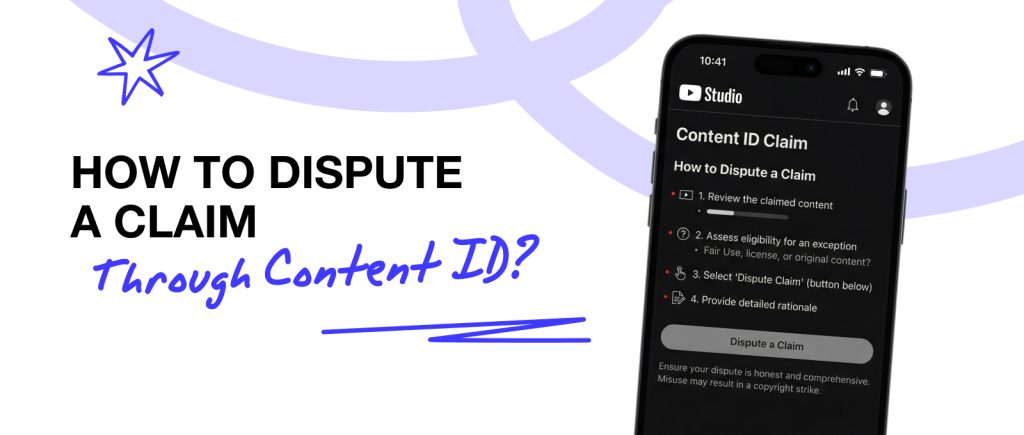
Firstly, you should know that the Content ID system is only available to official YouTube partners. For anyone else, though, here’s what you need to do to file an appeal.
- Disputing claim
Step one begins with checking YouTube Studio. Head to the Content tab and then select Video. Now, find the “Restrictions” column and hover your cursor over the “Copyright — Details” line. You should see the “What content infringes copyright” section pop up, and then look for the claim in question and click on Select actions — Dispute claim.
You can only dispute a video claim if you have a solid reason to do so, like when you can prove all the rights to the content. Once you’ve filed that dispute objection, the applicant needs to respond to it within 30 days. If they don’t, their application gets canceled.
- Filing an appeal
This option is only available for Content ID claims that block videos. When selecting this option, the initial dispute stage, which gives the applicant 30 days to respond, is skipped, and the process begins immediately with the filing of the appeal. After that, the applicant has seven days to respond, so the decision can be obtained more quickly.
Keep in mind that during the dispute process, the claimant can ask for the video to be taken down at any time because of copyright infringement. If this is done in compliance with all requirements, the video will be removed from YouTube, and the channel will receive a copyright infringement warning, which can only be contested by a counter-notification: being legally prepared for court.
- Counter notification
A counter notification is only filed if you’re planning to take the copyright strike all the way to court. That's the only time you’d need to submit one. As part of the YouTube Partner Program team, we’re not going to get involved with the legal side of things and can’t act as lawyers on behalf of either the creator or the platform as a whole. So if you’re going to send in a counter notification, you should be absolutely sure you're in the right.
If you’ve had a change of heart and no longer want to fight the claim, there are other ways to get out of the situation. For example, you could take the offending material out of your video or channel altogether.
Protect Your Content with Content ID
Get access to YouTube’s Content ID and expert support from Mediacube to handle claims, strikes, and copyright issues.
How to Protect Your Channel from Demonetization in 2026
To avoid demonetization or never face it at all isn’t about being careful, it’s about building a content system that just works with the rules from the very beginning. And we don’t talk about luck here either, because at the end of the day, everything begins with a thought-through strategy, the basis of which is built upon the advertiser-friendly content guidelines.
So here are some key rules of thumb to keep in mind. When you upload video:
- Prioritize original, high-quality content over leaning on the quantity of materials;
- Add some real, personal value when you borrow from others;
- Ditch the pre-made templates — they’ll only make you lazy;
- Use AI as a tool, not as a crutch;
- Keep an eye on policy updates — forewarned is forearmed.
Thriving channels are the ones that have a media brand mindset, focus on taking into account how their audience thinks, and make sure all their content is recognizable and identifiably their own.
Frequently Asked Questions on YouTube Demonetization
All in all, demonetization is not a life-long curse. You can get over it if you happen to face it, and you can avoid it if you are forewarned. Here, we gathered the most popular Q&As that cover the most common issues faced by YouTube creators who want to avoid being demonetized or deal with it faster.
What does "demonetized" mean on YouTube?
As a rule, your channel undergoes a combination of automated checks and manual reviews to see if it conforms to YouTube rules and guidelines. If there’s an issue or if it’s a repeated problem, then the YouTube team might decide to exclude you from YPP or terminate your channel.
I’ve got demonetized. What to do?
Your first step is to go to YouTube Studio to find out why you’ve been demonetized. Firstly, you fill an appeal and wait for the answer. Don’t rush to change it, or it’ll be a constant sign that you did have issues with your content. Then you audit and fix the issues only when you do a second appeal and request review, so that when the team reviews your content again, they will see that you’ve removed the problem. If you don't want to survive it alone, you can always partner with creator support team, like Mediacube.
Can I swear on YouTube without getting demonetized?
Yes, but only now and then, without abusing it. And still, there are high chances that you’ll get a yellow dollar sign. Don’t use it too early in the video, and don’t allow it to affect an advertiser’s suitability.
How to return monetization?
If your violation isn’t severe, you can restore monetization by fixing the issues, making sure everything is in order and original, and then submitting an appeal where you explain everything clearly.
Can AI voiceover be monetized?
Yes, it can, as long as it’s original for the most part. If you’re not letting it be low-quality, low-effort content, if you put yourself and your unique features, like the tone of voice.
Can I earn money outside YouTube?
Yes, you can diversify your income streams beyond AdSense, for example, by selling online courses, merch and digital downloads, like books and templates, and offering memberships. Membership programs allow creators to provide exclusive content to subscribers, creating a steady income stream.
Demonetization is a System, Not a Random Punishment
So probably now you know that demonetization is not just bad luck, it’s something that is totally predictable. If you start treating YouTube like the system it is, you can figure out the risks, stop demonetization before it happens, and get back on track quicker. But if you ignore how the system works, you can still end up losing your monetization even if your channel is doing well.
Mediacube works with creators in both cases: to sort out problems when the worst has already happened and before things even get bad. Prevention is the best option! Based on the work with our partners, the best support involves giving channels a good check-up to spot any hidden problems lurking in the background. We come up with strategies to change up content and provide a wide range of services and tools for YouTube creators so you can grow your channel carefree and earn money!
Even in the toughest cases, working together with an experienced team gives you a much better chance of getting back online. If your channel is already struggling with monetization from YouTube ads (and so on) or you want to avoid that nightmare before you start scaling up, it’s probably worth taking action sooner rather than later. The thing is, in 2026, it’s usually the main thing that stops a channel from growing and earning on YouTube: whether or not they understand how the system works and play by its rules.