YouTube remains the leader in the creator economy. This leading position is solidified by more than 2.7 billion people logging in every month and a search engine that’s competing with Google for supremacy.
But many creators and brands have picked up on a pretty important point: YouTube is the main HQ, but it’s not the only place where you can do business. By spreading the word about your brand across other platforms, you’re not deserting YouTube, you’re maximizing your reach and tapping into a fruitful revenue stream that exists in some seemingly random corners of the Internet. And it's no longer just YouTube where creators can grow a fanbase and start making some real cash through their content. Today, there’s a whole web of alternative platforms: each with its own style, format, way of connecting with your audience, and its own strategies for spreading ideas and words. There's always a question: Which short video platform should creators choose?
Below is our expert analysis of 15 platforms that can help complement your YouTube strategy and build a multi-stream business that’s steady and ready for whatever challenges the future throws at you.
Why Creators Use Alternative Platforms & How To Choose the Right One
The reason creators are trying new platforms is simple: audiences just aren’t hanging around in one place. Viewers these days are just as likely to be scrolling through entertainment, learning, or live channels on multiple apps.
According to the data, the global creator economy is now valued at a staggering $250 billion+, and it’s still growing fast. Millions of creators make a living through platform monetization, brand partnerships, subscriptions, and digital products. So it makes sense that today, diversifying is more important than ever. And they can present their activity on different platforms, adding this information and statistics via their media kit, which is an indicator of the professionalism of a creator.
Of course, creators are wary of relying entirely on one option. It is genuinely not safe. By using multiple channels, they can:
- avoid getting into an algorithm trap that suddenly doesn’t favour them;
- reach different types of audience on different platforms;
- experiment with YouTube trends and how they can be applicable outside the platform, and try different formats, like video, podcasts, written articles, and so on;
- diversify ways to make money to secure income.
In reality, creators who work across multiple platforms tend to have more stable and scalable businesses in the end. Diversifying your traffic sources can give you some room when your YouTube CPM fluctuates because of market changes.
In order to choose the right option, remember these factors that guide you during the decision-making process. When choosing which platforms to join up with, it’s less about which ones are trending and more about the kind of content you create and the audience you’re trying to reach. Creators need to think about three key things:
- Content style. Short clips tend to be popular on discovery-driven platforms, while long-form content, like tutorials or stories, does better in spaces where people already expect hours of in-depth stuff.
- Audience intent. Some platforms are for entertainment, others for building a community around a niche or sharing expertise.
- Monetization options. Each platform has different ways to make money: ad revenue sharing, subscriptions, tips, brand deals, and so on.
Before you start spreading your wings to other platforms, make sure your average view time on YouTube is in a good place, just like all metrics in general. That way you can be sure viewers are sticking around to watch your content here too.
Video content repurposing is a key part of growing in the creator economy. Instead of having to produce entirely new stuff for each platform, you can just adapt your existing content into different formats.
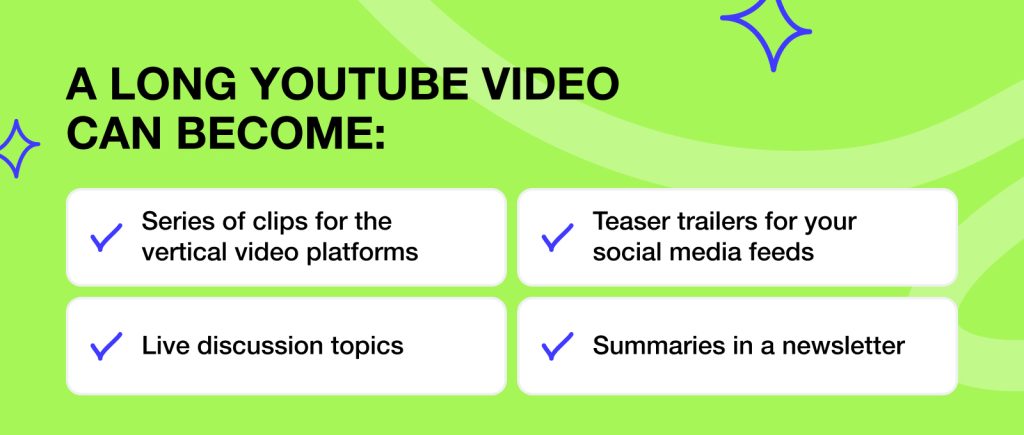
This is another reason why you shouldn’t be afraid to explore new territories — if you like doing YouTube collaborations, now you’ll be able to find new partners with new ideas.
Now, we’re going to explore each option based on what its main purpose is.
1. Video-on-Demand YouTube Alternatives
These platforms give you a similar ‘browse and search’ experience to YouTube, making them a great place to mirror your favorite videos to grab some extra ad revenue.
1.1 Rumble: The Profitable Licensing Platform
Rumble’s become a force to be reckoned with. It gave creators a “Creator-First” licensing deal that no one can match, even at YouTube’s massive scale. Rumble’s got a 2026 advantage with its syndication network. When you upload a video, you can go for a “Video Management” deal with Rumble and have your content put out on many major news sites.
- Pros: You basically keep 90% of the cash your videos make on Rumble; you can start making money straight away without needing to worry about your videos getting enough views first.
- Cons: The audience is pretty concentrated in news, tech, and commentary, so lifestyle and entertainment are still a bit out of topicality for CPMs.
1.2 Dailymotion: Still a Competitor for International Reach
Dailymotion’s been around in Europe and South Asia, places where YouTube just doesn’t get much traction, for a long time and is essential for these markets.
- Pros: easier to trend in places like France and Turkey; you get unlimited storage and a super lightweight 4K player you can use in your own blog or website.
- Cons: Ad-fill rates for US-based traffic can be a bit sad compared to YouTube’s premium standards.
1.3 Bilibili: The Gateway to the Chinese Market
If you’re looking to go global in 2026, Bilibili is pretty much your call. It’s like the “YouTube of China” for Gen Z. Bilibili uses a pretty unique ‘Bullet Chat’ system (or Danmu) that lets users’ comments fly across the video screen. This drives engagement that’s often 3 times higher than YouTube’s standard comment section.
- Pros: Massive audience plus a pretty healthy culture of fan-gifting and tipping.
- Cons: To really make it there, just translation won’t be enough, you need to localize your content, get it just right for the local culture.

Learn more
Want to Grow Faster on YouTube? Get a free channel audit from Mediacube experts. Identify what’s holding you back and receive a clear action plan to boost your growth. [Get a Free Audit](https://mediacube.io/form?page=&form=welcome)
[Get a Free Audit](https://mediacube.io/form?page=&form=welcome)2. Live-Streaming YouTube Alternatives
Streaming proved to be one of the best ways to connect with the audience and make it feel personal. But here, when you choose the live-streaming platform, you observe your revenue goals first.
2.1 Twitch: the Community Standard
Being integrated into the Amazon ecosystem, Twitch is the platform that everyone looks at as a standard for live engagement and a place to build a strong fanbase.
- Pros: Amazon Prime integration allows fans to support you directly; it has the most advanced alert system for broadcasts.
- Cons: It has the highest tax — 50/50 revenue split.
2.2 Kick: The High-Margin Disruptor
Kick is a revolutionary among similar platforms since it offers its users a 95/5 split, which allows vloggers to get almost all the income. Isn’t it cool?
- Pros: Maximum profit per subscriber; Creator Incentive Program provides qualifying streamers with a stable wage.
- Cons: Audience is smaller in comparison to Twitch; brand-safety moderation is currently in work.
3. The Social Video YouTube Alternatives
Here, by the name Social Video, goes the content in social media where you find your audience and then, you funnel it back to your YouTube channel or any private membership platform.
3.1 TikTok: The Search-Driven Discovery Engine
Due to its perfected SEO tools now, TikTok is a highly legitimate competitor, especially in terms of search.
- Pros: The virality potential is impressive; TikTok Shop allows you to sell merch directly within videos.
- Cons: High viewer churn; Creator Reward payouts are lower than in AdSense, for example.
3.2 Facebook Video: The Audience-oriented Strategy
Meta’s Performance Bonus can become your major revenue stream — but it’ll only work if you have a mature audience with high engagement. Usually, it’s perfect for DIY, parenting, and politics.
- Pros: Impressive older audience reach with higher disposable income.
- Cons: AI-driven copyright enforcement can flag repurposed content.
3.3 Instagram Reels: The Brand Deal Anchor
Being perfect for people who focus on lifestyle, fashion, travel, etc., Instagram Reels is one of the top platforms for landing sponsorships besides YouTube. Its shopping integration makes it easy for people to go from discovering something to making a purchase.
- Pros: The highest conversion rate for the mentioned theme sponsorships; Instagram Subscriptions offers recurring revenue.
- Cons: Unfortunately for business accounts, organic reach is about “pay-to-play” and therefore, less friendly.
3.4 X (Video): Catching the Culture Wave
X has made the switch to being a video priority platform, and as a result, is really encouraging high-quality long-form uploads from journalists and commentators to start sharing their work there.
- Pros: After all the fees, you get to keep about 97% of your revenue; your audience has a Verified badge, so you know who you are talking to.
- Cons: All of this requires a paid X Premium subscription; your payout is going to be tied to how much engagement you get from the premium users.
4. Professional & Subscription YouTube Alternatives
These options are for creators who want to have and maintain complete control over the relationship with their audience and bypass the algorithms.
4.1 Vimeo (OTT): Your Private TV Channel
Vimeo OTT is the perfect platform for creators who want the freedom to control distribution and branding without having to rely on the whims of algorithms. By building your own custom subscription-based streaming service, you get to create a premium ad-free viewing experience along with your own custom apps. Commonly used by filmmakers, fitness instructors, educators, and all sorts of niche creators.
- Pros: There are no annoying ads; you have control over the player branding; opportunity to launch your own branded apps on Apple TV and Roku.
- Cons: Monthly payment is quite expensive; you need to attract an audience from YouTube and other social media in order to get more views.
4.2 Wistia: Focus on ROI
Commonly suitable for businesses and course curators, it uses analytics and tools to transform viewers into leads. Keep in mind that it focuses on sales, not views.
- Pros: Heatmap tool helps you see the moments where drop-off happens; a unique built-in email capture form to grow your newsletter audience.
- Cons: Since it’s a business platform, almost no one will discover your content by accident.
4.3 Patreon: Your Most Loyal Fans Monetization
On Patreon, you can offer tier-based subscriptions. Without depending on ads, you control your monthly income by producing special videos, arts, community access, and so on. Usually, a creator brings already existing subscribers from other socials.
- Pros: You have a fixed, stable monthly income; there is a built-in video hosting platform that allows your most loyal fans exclusive access.
- Cons: Commission is 8-12%; the overall discovery of your content is quite limited.
4.4 Nebula: Education Orbit
Nebula’s primary attention is on high-end educational content. It is run by its creators, which means that strong brand alignment and higher-quality audience engagement are what you can expect.
- Pros: Ad-free and subscription-based platform curated by a collective of creators; profit-sharing model is decent.
- Cons: To get there, you have to be invited; to be invited, you need to have very specific, high-quality, educational content.
5. Decentralized Networks YouTube Alternatives
These platforms embody a decentralized archive, securing your content from disappearing into the void.
5.1 Odysee (LBRY Protocol): The Blockchain Back-Up
LBRY Protocol allows you to avoid censorship and hold more control over what you’re posting. It’s not like a usual video-hosting, you use it like a copy secured by an awesome blockchain network that ensures all your content is safe.
- Pros: Can be linked to YouTube — the upload is immediately copied to Odysee; for all the views, you’re paid in crypto.
- Cons: Local community is small; for people who aren't into crypto and all that, it can be quite a puzzle to create a wallet and understand the mechanics.
5.2 DTube: A Peer-to-Peer Choice
It is another good example of a strong, decentralized system. There is no reliance on ads and sponsorships, because you earn crypto from your community — by voting, curation, and comments. Here, transparency is a priority.
- Pros: There is no central CEO or any authority; rewards are both for creators and curators (voters).
- Cons: In comparison with YouTube or Vimeo, time of uploading is way slower.
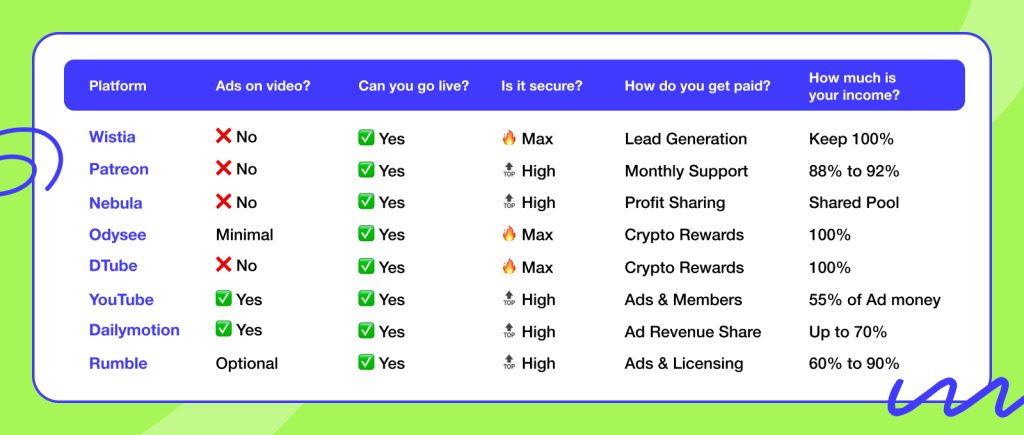
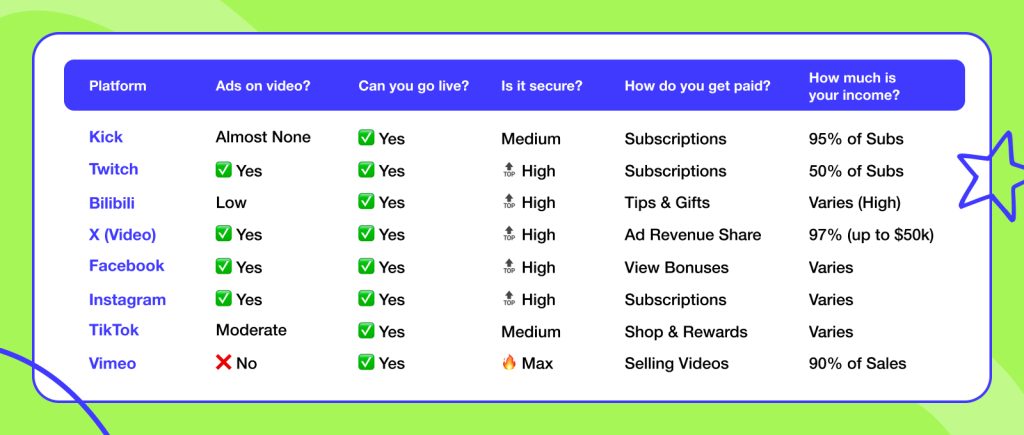
To conclude and make the comparison visually easy, explore the table below.
- -
Frequently Asked Questions on YouTube Alternatives
The variety of options can seem overwhelming, we know! But here, we summed up only the necessary information that helps you navigate through the sea of options besides YouTube.
- Can using other platforms negatively affect my YouTube channel?
Not at all. First of all, it’s a perfect opportunity to do a cross-promotion. Many creators use platforms like Rumble to put up some behind-the-scenes footage or TikTok to tease a new video to drive traffic back to their main YouTube channel. It’s a great strategy to have an ecosystem where all roads lead to YouTube.
- How can I manage different payment systems at once?
If you’re a serious creator, you use financial apps like MC Pay to bring all your earnings from, for example, YouTube, Facebook, and Kick into one easy-to-use dashboard. That way, you get daily payouts so you don’t have to wait for several different monthly cheques.
- What platform should I choose besides YouTube?
That depends on what sort of content you produce and your expectations for audiences and income. If you do news or tech, give Rumble a shot. If you‘re a streamer, Kick might be a good choice. If you want to get in front of a global audience, Bilibili is probably your best bet.
- How do I protect my content from being stolen on these sites?
To be honest, diversifying your content does increase the risk of piracy. You can use CPSs for monitoring that you are the only one who gets paid for the uploaded content.
- Do I have to make unique content for every site?
No! Some creators use this rule: 1-3-10. Make one good video, upload it to three VOD platforms, and for social discovery, chop it into 10 edits.
YouTube + The World
Let’s make a conclusion here: YouTube is the foundation, but the alternatives are the skyscrapers rising high to the sky. By making YouTube your main marketing HQ and then getting established on several other platforms, you effectively create a business that is resilient even in the face of obstacles. Successful creators treat each platform as part of a whole web of interconnected things rather than stand-alone channels.
Managing all that complexity on your own can be confusing. That’s why by tapping into the financial, legal, localization, and so many other tools that Mediacube has at its disposal, you can get back to doing what you do best — creating — while Mediacube takes care of the back-end business of running your content empire like a well-oiled mechanism.
Ready to put your 2026 distribution map into action? Let’s get your content all around the world and grab the maximum revenue possible from the digital landscape.